Tuesday, November 4, 2014
5 a.m. = semi-random thoughts
-Babies don't really have special, stay-at-home wear, do they? I mean, I have my favorite "not going anywhere" outfits, like the rolled-up blue jeans with the growing hole in the left knee and the v-necked shirt with orange and pink shells. But babies these days seem like they're always so fashionable, so ready-to-go. Obviously they don't decide what to wear, period, let alone what to wear when they're having a pajamas day. I mean, I know they have pajamas, but do they have special, extra-laid back pajamas?
-Why are all my insecurities about teaching channeled through political metaphors? For instance, why do I sometimes wonder, "Am I the Jimmy Carter of teachers?"
-Speaking of politics, I still want to read an academic paper on Elmo and Bob Dole's use of the third person.
-Yesterday the student I bought my coffee from told me that the puppy he and his wife are fostering is named Julie Taylor. I was like, "Julie Taylor...why does that name sound so familiar?" Friday Night Lights, he told me, and I scream-laughed with joy. Apparently all current puppies at Motley Zoo Animal Rescue are named after characters from the show. One of Julie Taylor's brothers is Matt Saracen. Hilarious but also a bit creepy, right?

Saturday, October 11, 2014
Why Are Almost all of These Women White?
C'mon, Grey Lady, get it together. It's only been a few weeks since The New York Times caused an uproar for publishing Alessandra Stanley's inaccurate, clueless, and offensive piece about Shonda Rhimes and her TV creations. One of the conclusions that Margaret Sullivan, the Public Editor, reached was that a lack of diversity in the ranks of culture editors could have contributed to the piece's publication; she notes that, "among the 15 culture editors...just a few are nonwhite."
Now this week's Sunday Book Review is focused on Women & Power, and what do you see when you scroll (or flip) through the contents? Of the 13 photos or drawings of women or girls that accompany each article, 11 are white. (I'm providing the link here although it appears that the table of contents in this order will only be available until the next Book Review replaces it). There's Diane Sawyer, Lena Dunham, Gail Sheehy, and Kirsten Gillibrand, among others, and then there's Sonia Sotomayor and a story about The Underground Girls of Kabul, which chronicles the practice of passing girls off as boys in Afghanistan (one such girl and her mother appear in the accompanying photo). Two books profiling nonwhite women, two images; that's it. This even when some stories - such as a piece about abortion rights and the origins of birth control pills - involve and affect all women and are illustrated with drawings, drawings that easily could have depicted nonwhite women.
At the end of her piece about the Stanley article, Sullivan wrote, "This contentious chapter may not seem like a welcome gift to anyone involved. But if The Times takes it seriously – looking hard at its diversity and its editing practices — it can be exactly that." It's clear that The Times isn't looking hard enough; I plan to email Sullivan to tell her just that.
Now this week's Sunday Book Review is focused on Women & Power, and what do you see when you scroll (or flip) through the contents? Of the 13 photos or drawings of women or girls that accompany each article, 11 are white. (I'm providing the link here although it appears that the table of contents in this order will only be available until the next Book Review replaces it). There's Diane Sawyer, Lena Dunham, Gail Sheehy, and Kirsten Gillibrand, among others, and then there's Sonia Sotomayor and a story about The Underground Girls of Kabul, which chronicles the practice of passing girls off as boys in Afghanistan (one such girl and her mother appear in the accompanying photo). Two books profiling nonwhite women, two images; that's it. This even when some stories - such as a piece about abortion rights and the origins of birth control pills - involve and affect all women and are illustrated with drawings, drawings that easily could have depicted nonwhite women.
At the end of her piece about the Stanley article, Sullivan wrote, "This contentious chapter may not seem like a welcome gift to anyone involved. But if The Times takes it seriously – looking hard at its diversity and its editing practices — it can be exactly that." It's clear that The Times isn't looking hard enough; I plan to email Sullivan to tell her just that.
Under the Dome with Only Microsoft for Company
Confession: I have not read Under the Dome, but I have watched it. It is so very nearly bad enough to be wonderful, but not quite. Anyway, I was curious how the book compared, so I read James Parker's New York Times review, which includes plot details such as President Obama writing a letter to the town's dome-entrapped citizens and a second selectman seizing control of the police department, ready to enact his right wing agenda now that de facto secession from the U.S. government has occurred. Parker closes:
The coalition that forms against him includes a journalist, a librarian, an Iraq
veteran, some acned skateboarders and an English professor from
Massachusetts who (rather wonderfully) has just edited an issue of
Ploughshares. Get ready, libruls, King seems to be saying: If the dome
comes down, you’re going to need one another.
In other words, it's the then-present day of 2009, a year after Obama's election, and it's recognizably our world, complete with our president, our war, and our literary magazines. It's got guts and gore, but it also has a political viewpoint.
In contrast, on the TV show the Iraq War veteran is retained, as well as the power-hungry government official, but there's nothing Iraq or Tea Party-specific about either of them. And the Zuzu's petals of the whole thing, Ploughshares? It's not there either, George. Yet we're in our world, product-placement-wise, from Microsoft to Prius, and others have written about the strange and unlikely ways these products have been introduced on the show. I know I'm writing seriously about a not-serious show and a book I haven't, ahem, read, but I think it's worth noting that Bad Stephen King Adaptation + Microsoft doesn't only = cringe-inducing viewing. It's that some proper nouns have ascended while others have been erased. It's Microsoft - Politics which creates such an empty vessel.
Not every story based in our world needs to ground itself in our real political names; of course alternate-reality narratives and straight-up allegories can offer politically and culturally astute commentary. I just think it's interesting when we keep the signifiers without the significance; for example, keeping the Iraq War veteran in name only. What does this accomplish? What box does it check off? Is it just a shorthand for, "This character is an experienced badass who has been through the shit"? Does the director think, "Let's show a photo of him with his Army buddies and their guns and call it a day"? How do actual Iraq War veterans feel about such characters?
I'm writing this late at night/early in the morning, so maybe my brain is fuzzified, but I'm also wondering now about political cameos on shows such as The Good Wife. Is this another example of a signifier without significance?
The coalition that forms against him includes a journalist, a librarian, an Iraq
veteran, some acned skateboarders and an English professor from
Massachusetts who (rather wonderfully) has just edited an issue of
Ploughshares. Get ready, libruls, King seems to be saying: If the dome
comes down, you’re going to need one another.
In other words, it's the then-present day of 2009, a year after Obama's election, and it's recognizably our world, complete with our president, our war, and our literary magazines. It's got guts and gore, but it also has a political viewpoint.
In contrast, on the TV show the Iraq War veteran is retained, as well as the power-hungry government official, but there's nothing Iraq or Tea Party-specific about either of them. And the Zuzu's petals of the whole thing, Ploughshares? It's not there either, George. Yet we're in our world, product-placement-wise, from Microsoft to Prius, and others have written about the strange and unlikely ways these products have been introduced on the show. I know I'm writing seriously about a not-serious show and a book I haven't, ahem, read, but I think it's worth noting that Bad Stephen King Adaptation + Microsoft doesn't only = cringe-inducing viewing. It's that some proper nouns have ascended while others have been erased. It's Microsoft - Politics which creates such an empty vessel.
Not every story based in our world needs to ground itself in our real political names; of course alternate-reality narratives and straight-up allegories can offer politically and culturally astute commentary. I just think it's interesting when we keep the signifiers without the significance; for example, keeping the Iraq War veteran in name only. What does this accomplish? What box does it check off? Is it just a shorthand for, "This character is an experienced badass who has been through the shit"? Does the director think, "Let's show a photo of him with his Army buddies and their guns and call it a day"? How do actual Iraq War veterans feel about such characters?
I'm writing this late at night/early in the morning, so maybe my brain is fuzzified, but I'm also wondering now about political cameos on shows such as The Good Wife. Is this another example of a signifier without significance?
Thursday, September 18, 2014
Throwback Thursday

Monday, September 15, 2014
Steinbeck vs. Very Tall Trees (or Things to Learn in California)
This summer I taught a class, re-watched Family Ties, and finally read The Grapes of Wrath, which I loved and was not alone in finding unfortunately yet inspiringly still relevant. So I was excited to visit the National Steinbeck Center in Salinas, CA. If you haven't been, and you're a mostly-uninformed Steinbeck admirer to any degree, I recommend it. I learned about his reporting - on migrant workers and World War II, among other subjects - how the themes of The Grapes of Wrath earned him an invitation to Russia at the start of the Cold War (not exactly a common occurrence), and how critical derision about him receiving the Nobel Prize in Literature caused him to give up writing fiction. (It eventually became clear that he never truly gave it up). I learned about books I'd never knew he'd written - In Dubious Battle, about a farm workers' strike; The Winter of our Discontent, about consumerism and morality in the U.S. - and was reminded of America and Americans, a collection of essays and the last book of his published while he was alive.
There was also a very cool exhibit about a group that recreated the Joads' journey from Oklahoma to California to mark the 75th anniversary of The Grapes of Wrath; they collected oral histories from workers, activists, and other people, some of which are shared in the exhibit. (You can find more info about it here, too; although it says the exhibit ended in July, they must have decided to extend it).
But the center was also disappointing and odd: if you were unlike me and were mostly-informed about Steinbeck, there's little offered that you won't already know; the main exhibit is large and contains a lot of information, but there's no commentary, let alone analysis, that seeks to puzzle out themes, arcs, or evolutions in his life or work or tie them to contemporary issues. (The possible exception is a collection of "Steinbeck in the news"-type clippings, but it was dominated by stories of the recent big-name Broadway revival of Of Mice and Men). And in some cases, there are frustrating, gaping holes: a display of Steinbeck's college correspondence names the recipient but nothing about who she was.
What's also odd is the museum's apparent desire to satisfy both adults and children; there are a lot of interactive features, some of which can cross generations. (For example, the In Dubious Battle section includes two candlestick telephones; you pick up the receiver to hear dialogue from the book). But others, such as a red pony that children can climb onto, well, not so much. I've never read The Red Pony, but a cursory glance at some search results reveals that it's generally taught at the 6th grade level or higher. But the museum pony seems aimed at much younger kids (or middle schoolers who want to - wait for it! - horse around). It's great to try to get kids excited about literature, but at what point are book-related activities made so accessible to young ages, the "related" part stretched so thin, that the book itself is lost? When kids have a chance to practice braiding a rope, are they learning about a book or about…braiding a rope? Meanwhile, the adults among you are wondering, Who was that woman he wrote the letters to?!
I'm a sucker for the interactive as much as the next person; when I see a question in a big font asking, "How did Lennie want his beans?" and the instruction, "Lift the can," I lift the can. (Spoiler alert: there's a bottle of ketchup under them thar can). Then later in my trip, when I'm reading an educational display in Redwood National and State Parks about what makes redwoods so resilient, and it ends with the question, "What do you think is the biggest threat to redwoods today?", my first thought is, What do I lift to find the answer?!
Then I think: oh, right. Humans.
There was also a very cool exhibit about a group that recreated the Joads' journey from Oklahoma to California to mark the 75th anniversary of The Grapes of Wrath; they collected oral histories from workers, activists, and other people, some of which are shared in the exhibit. (You can find more info about it here, too; although it says the exhibit ended in July, they must have decided to extend it).
But the center was also disappointing and odd: if you were unlike me and were mostly-informed about Steinbeck, there's little offered that you won't already know; the main exhibit is large and contains a lot of information, but there's no commentary, let alone analysis, that seeks to puzzle out themes, arcs, or evolutions in his life or work or tie them to contemporary issues. (The possible exception is a collection of "Steinbeck in the news"-type clippings, but it was dominated by stories of the recent big-name Broadway revival of Of Mice and Men). And in some cases, there are frustrating, gaping holes: a display of Steinbeck's college correspondence names the recipient but nothing about who she was.
What's also odd is the museum's apparent desire to satisfy both adults and children; there are a lot of interactive features, some of which can cross generations. (For example, the In Dubious Battle section includes two candlestick telephones; you pick up the receiver to hear dialogue from the book). But others, such as a red pony that children can climb onto, well, not so much. I've never read The Red Pony, but a cursory glance at some search results reveals that it's generally taught at the 6th grade level or higher. But the museum pony seems aimed at much younger kids (or middle schoolers who want to - wait for it! - horse around). It's great to try to get kids excited about literature, but at what point are book-related activities made so accessible to young ages, the "related" part stretched so thin, that the book itself is lost? When kids have a chance to practice braiding a rope, are they learning about a book or about…braiding a rope? Meanwhile, the adults among you are wondering, Who was that woman he wrote the letters to?!
I'm a sucker for the interactive as much as the next person; when I see a question in a big font asking, "How did Lennie want his beans?" and the instruction, "Lift the can," I lift the can. (Spoiler alert: there's a bottle of ketchup under them thar can). Then later in my trip, when I'm reading an educational display in Redwood National and State Parks about what makes redwoods so resilient, and it ends with the question, "What do you think is the biggest threat to redwoods today?", my first thought is, What do I lift to find the answer?!
Then I think: oh, right. Humans.
Friday, September 12, 2014
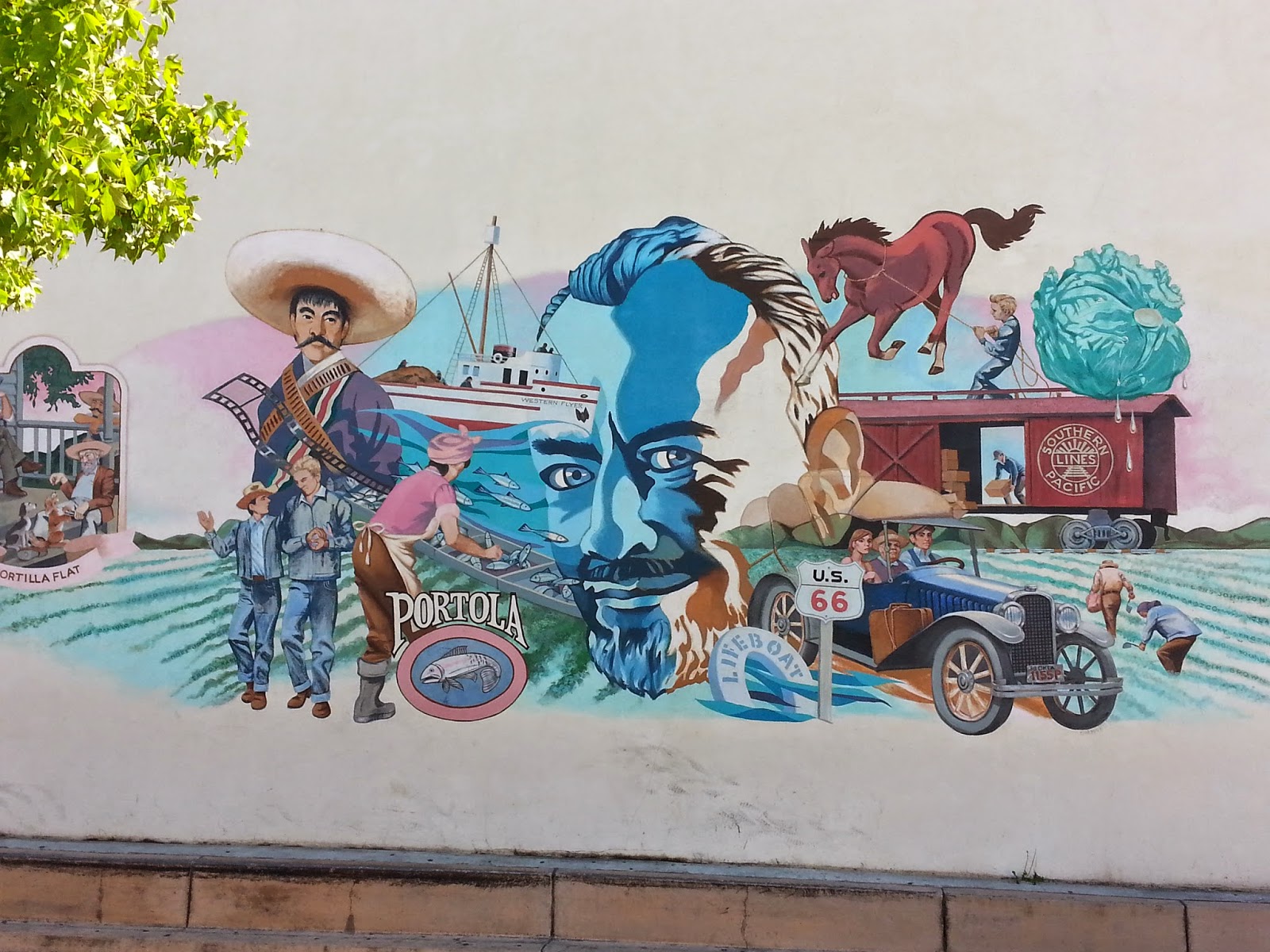
Outside the National Steinbeck Center
Just got back from a great trip, which included a stop in Salinas, CA. I'm tired now, but maybe I'll write more about it later.
Thursday, September 4, 2014
Amendments, Corrections, and Recommendations: A Final Family Ties Post*

- I wondered if the Keatons had an answering machine; well, they do get one in season four, and the kids spend one episode changing the outgoing messages on each other, but then it never really figures in the plot again. (It seems to physically disappear, too, but don't quote me on that).

- I wrote that we never see the Obecks - the Keatons' neighbors until they move out and the Thompsons move into that house - or Chrissy, Jennifer's best friend, but neither of those claims turned out to be true. We do meet one Obeck, daughter Liz, in the episode "The Big Fix" in season five. At the end of season five we also meet Chrissy, in a two-part episode about Jennifer trying to change to fit in with a popular crowd.

"It's My Party" is a great example of a strange and not-great phenomenon on Family Ties: airing episodes out of order. Characters, especially Jennifer and Andrew, are clearly younger in "Party" than they have been for the entire season, and Alex's girlfriend Ellen is still around, even though she left for Paris ages ago. This episode was filmed in season four but - saved? forgotten? deemed subpar but trotted out to fill scheduling needs? It's unclear. (Which is not to say it doesn't have its great moments, my favorites being when Ellen gives Jennifer an old Mondale and Ferraro shirt for her birthday and when the parents try to decipher a note Jennifer has left them; it's a minefield of "like" and "okay?").
 |
| What can I say? I'm a sucker for political t-shirts... |
 |
| …and textual analysis. |
- One more update before we move on: I speculated that one reason the show creates a friend for Alex only to kill him off might have been because the actors who had played his established friends were not available. I don't know if the writers or casting director considered killing off Timothy Busfield or Jeffrey Joseph's characters for "A, My Name is Alex" in 1987, but maybe you've heard of a little thing called thirtysomething? That started airing in 1987, as did The Popcorn Kid, a TV series that Joseph had a recurring part in. So these actors were a little busy. (Plus, Busfield had already been assigned double duty on the show; in addition to being Alex's friend, he was also cast in an episode's flashback sequence as one of college-age Steven's friends. But then again, what's two roles for the same actor? The show went higher for others).

 |
| Both Timothy Busfield (top) and Jeffrey Joseph (above) appeared as Alex's friends in two episodes. That amounted to close friendship in the Family Ties universe. |
Now for some recommendations! Let's start with a few individual scenes and then go to whole episodes. Of course, it depends on what you're looking for:
- Are you looking for some feminist education for little boys? Look no further than "The Way We Were" in season six, which opens with Alex coming home to find his parents asleep on the couch and Andy playing garage. Alex sees a Barbie doll and picks it up. "What's she doing here?" he asks.
"Barbie owns the garage?"
"Really she's in Congress, but on weekends she's a mechanic."
"I think I see mom's influence here," Alex says.
"She also won the Nobel Prize in Physics," Andy adds.
 |
| The debate about Barbie's identity devolves into a tug of war. These three actors are routinely great together. |
- Or maybe you feel stifled on the set and you want to see footage filmed outside? This happens rarely on the show, and the first such images don't occur until the end of season three in the two-part episode "Remembrance of Things Past." Steven and the family return to his childhood home in Buffalo; his father has died and his mother is thinking about selling the house. Steven visits his father's grave.

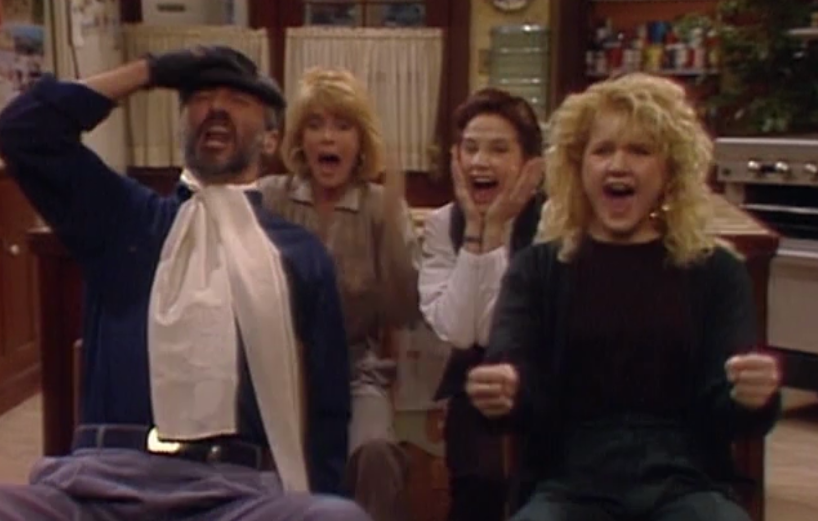
- Or perhaps you long for some good old-fashioned miming. When Jennifer gets her learner's permit in the season seven episode, "My Best Friend's Girl," Steven insists on giving her driving lessons. This includes a simulation in the kitchen, during which he says she ran a red light. Jennifer counters that there's a cop behind them. "I'm gonna try to lose him," she says.


As for whole episodes, that also depends on what you're looking for. But I will say that if you're a teacher or interested in education, you might find the episodes that center around teachers notable.
- "Little Man on Campus" in season three is about Alex starting college and struggling: he considers dropping American Government because he got an F on his first paper - he doesn't think he can hack it in that class. (Notice how it doesn't occur to him to blame the teacher or make excuses for himself). But when he goes to drop the class, his teacher questions him until he gets Alex to understand how to make an original argument. And it's not an abstract discussion - it's a conversation, and argument, about Eugene Debs and Oliver Wendell Holmes.
- "Paper Chase," the final episode of season four, is about how Mallory nearly flunks her history class and doesn't graduate from high school. But with the encouragement of her family, boyfriend, and teacher, she passes her oral exam and graduates after all. Her requests for extra credit are rebuffed; her only recourse is hard work, and it works. (It's also fun to see the oral exam, which people such as Rebecca Schuman have tried to revive, in messy, Socratic action).
 |
| Skippy graduates too! How could I get this far with only the merest nods at Marc Price, who plays neighbor Skippy Handelman? |
 |
| For instance, this shirt: starting in season five and continuing until the end of the show, you cannot swing a dead cat without hitting Skippy in this shirt. I still haven't figured out what that woman in the blue dress is doing. |
- There's "Paper Lion" in season five, which I mentioned in my discussion of Mason Adams in the in memoriam post. It's an interesting story: he's a longstanding, well-regarded economics professor, but he feels pressure to publish from the administration, so he pretends the data in his latest work isn't flawed. Alex calls him out on it, and the professor ultimately comes clean. "I am a teacher," he declares from the pulpit at an awards ceremony. "And in a college, there's nothing more important than that." Aw, sweetie, you want to say, reaching across the screen and back through time. What a lovely thought.
- And finally, there's the two-part episode "Read It and Weep" in season six. Jennifer wants to do her book report on Huckleberry Finn, but the school board has banned it (and a number of other books). She refuses to change her book and is suspended. Her teacher is afraid of supporting her publicly, thinking he'll lose his job, but after hearing her speak up at a community meeting, he and other teachers decide that they're going to stage a walk out to protest her suspension. This episode, like "Paper Lion," points toward the challenges teachers face, but although it also features someone proclaiming, "I am a teacher," it seems less enamored of the lone individual as role model; it suggests that an answer can be found in collective action.
The vision of teaching on the show is lecture-driven, overwhelmingly male (of the aforementioned teachers, only Mallory's is female), and entirely white. So there are very real limitations to and problems with it - and there were in the '80s, too. But it makes for an interesting artifact with some still-applicable lessons.
On a different note, I'll also recommend "Heartstrings" from season seven, which was the only three-part episode in the show's run. Steven has a heart attack and undergoes surgery. There are flashbacks, but unlike with a clip show, they are to scenes we've never seen before, and they add to the story. Three episodes gives the narrative enough space to move from sadness and fear to humor and strength without feeling cramped or rushed.

Finally, some recommendations for further reading:
- The 2013 Rolling Stone interview with Michael J. Fox gives a comprehensive, introspective overview of his life and career and where he is now.
- The New York Times Style section profiled Meredith Baxter's wedding last year, at which Michael Gross gave a toast.
- Also in the Times, a great piece in July by Eric Schulmiller about anticipating catching up with the timeline from Back to the Future and the difference between our future as we imagined it and as we live it.
- And show creator Gary David Goldberg's obituary (he died last year).
Subscribe to:
Posts (Atom)