C'mon, Grey Lady, get it together. It's only been a few weeks since The New York Times caused an uproar for publishing Alessandra Stanley's inaccurate, clueless, and offensive piece about Shonda Rhimes and her TV creations. One of the conclusions that Margaret Sullivan, the Public Editor, reached was that a lack of diversity in the ranks of culture editors could have contributed to the piece's publication; she notes that, "among the 15 culture editors...just a few are nonwhite."
Now this week's Sunday Book Review is focused on Women & Power, and what do you see when you scroll (or flip) through the contents? Of the 13 photos or drawings of women or girls that accompany each article, 11 are white. (I'm providing the link here although it appears that the table of contents in this order will only be available until the next Book Review replaces it). There's Diane Sawyer, Lena Dunham, Gail Sheehy, and Kirsten Gillibrand, among others, and then there's Sonia Sotomayor and a story about The Underground Girls of Kabul, which chronicles the practice of passing girls off as boys in Afghanistan (one such girl and her mother appear in the accompanying photo). Two books profiling nonwhite women, two images; that's it. This even when some stories - such as a piece about abortion rights and the origins of birth control pills - involve and affect all women and are illustrated with drawings, drawings that easily could have depicted nonwhite women.
At the end of her piece about the Stanley article, Sullivan wrote, "This contentious chapter may not seem like a welcome gift to anyone
involved. But if The Times takes it seriously – looking hard at its
diversity and its editing practices — it can be exactly that." It's clear that The Times isn't looking hard enough; I plan to email Sullivan to tell her just that.
Showing posts with label books. Show all posts
Showing posts with label books. Show all posts
Saturday, October 11, 2014

Under the Dome with Only Microsoft for Company
Confession: I have not read Under the Dome, but I have watched it. It is so very nearly bad enough to be wonderful, but not quite. Anyway, I was curious how the book compared, so I read James Parker's New York Times review, which includes plot details such as President Obama writing a letter to the town's dome-entrapped citizens and a second selectman seizing control of the police department, ready to enact his right wing agenda now that de facto secession from the U.S. government has occurred. Parker closes:
The coalition that forms against him includes a journalist, a librarian, an Iraq
veteran, some acned skateboarders and an English professor from
Massachusetts who (rather wonderfully) has just edited an issue of
Ploughshares. Get ready, libruls, King seems to be saying: If the dome
comes down, you’re going to need one another.
In other words, it's the then-present day of 2009, a year after Obama's election, and it's recognizably our world, complete with our president, our war, and our literary magazines. It's got guts and gore, but it also has a political viewpoint.
In contrast, on the TV show the Iraq War veteran is retained, as well as the power-hungry government official, but there's nothing Iraq or Tea Party-specific about either of them. And the Zuzu's petals of the whole thing, Ploughshares? It's not there either, George. Yet we're in our world, product-placement-wise, from Microsoft to Prius, and others have written about the strange and unlikely ways these products have been introduced on the show. I know I'm writing seriously about a not-serious show and a book I haven't, ahem, read, but I think it's worth noting that Bad Stephen King Adaptation + Microsoft doesn't only = cringe-inducing viewing. It's that some proper nouns have ascended while others have been erased. It's Microsoft - Politics which creates such an empty vessel.
Not every story based in our world needs to ground itself in our real political names; of course alternate-reality narratives and straight-up allegories can offer politically and culturally astute commentary. I just think it's interesting when we keep the signifiers without the significance; for example, keeping the Iraq War veteran in name only. What does this accomplish? What box does it check off? Is it just a shorthand for, "This character is an experienced badass who has been through the shit"? Does the director think, "Let's show a photo of him with his Army buddies and their guns and call it a day"? How do actual Iraq War veterans feel about such characters?
I'm writing this late at night/early in the morning, so maybe my brain is fuzzified, but I'm also wondering now about political cameos on shows such as The Good Wife. Is this another example of a signifier without significance?
The coalition that forms against him includes a journalist, a librarian, an Iraq
veteran, some acned skateboarders and an English professor from
Massachusetts who (rather wonderfully) has just edited an issue of
Ploughshares. Get ready, libruls, King seems to be saying: If the dome
comes down, you’re going to need one another.
In other words, it's the then-present day of 2009, a year after Obama's election, and it's recognizably our world, complete with our president, our war, and our literary magazines. It's got guts and gore, but it also has a political viewpoint.
In contrast, on the TV show the Iraq War veteran is retained, as well as the power-hungry government official, but there's nothing Iraq or Tea Party-specific about either of them. And the Zuzu's petals of the whole thing, Ploughshares? It's not there either, George. Yet we're in our world, product-placement-wise, from Microsoft to Prius, and others have written about the strange and unlikely ways these products have been introduced on the show. I know I'm writing seriously about a not-serious show and a book I haven't, ahem, read, but I think it's worth noting that Bad Stephen King Adaptation + Microsoft doesn't only = cringe-inducing viewing. It's that some proper nouns have ascended while others have been erased. It's Microsoft - Politics which creates such an empty vessel.
Not every story based in our world needs to ground itself in our real political names; of course alternate-reality narratives and straight-up allegories can offer politically and culturally astute commentary. I just think it's interesting when we keep the signifiers without the significance; for example, keeping the Iraq War veteran in name only. What does this accomplish? What box does it check off? Is it just a shorthand for, "This character is an experienced badass who has been through the shit"? Does the director think, "Let's show a photo of him with his Army buddies and their guns and call it a day"? How do actual Iraq War veterans feel about such characters?
I'm writing this late at night/early in the morning, so maybe my brain is fuzzified, but I'm also wondering now about political cameos on shows such as The Good Wife. Is this another example of a signifier without significance?
Monday, September 15, 2014
Steinbeck vs. Very Tall Trees (or Things to Learn in California)
This summer I taught a class, re-watched Family Ties, and finally read The Grapes of Wrath, which I loved and was not alone in finding unfortunately yet inspiringly still relevant. So I was excited to visit the National Steinbeck Center in Salinas, CA. If you haven't been, and you're a mostly-uninformed Steinbeck admirer to any degree, I recommend it. I learned about his reporting - on migrant workers and World War II, among other subjects - how the themes of The Grapes of Wrath earned him an invitation to Russia at the start of the Cold War (not exactly a common occurrence), and how critical derision about him receiving the Nobel Prize in Literature caused him to give up writing fiction. (It eventually became clear that he never truly gave it up). I learned about books I'd never knew he'd written - In Dubious Battle, about a farm workers' strike; The Winter of our Discontent, about consumerism and morality in the U.S. - and was reminded of America and Americans, a collection of essays and the last book of his published while he was alive.
There was also a very cool exhibit about a group that recreated the Joads' journey from Oklahoma to California to mark the 75th anniversary of The Grapes of Wrath; they collected oral histories from workers, activists, and other people, some of which are shared in the exhibit. (You can find more info about it here, too; although it says the exhibit ended in July, they must have decided to extend it).
But the center was also disappointing and odd: if you were unlike me and were mostly-informed about Steinbeck, there's little offered that you won't already know; the main exhibit is large and contains a lot of information, but there's no commentary, let alone analysis, that seeks to puzzle out themes, arcs, or evolutions in his life or work or tie them to contemporary issues. (The possible exception is a collection of "Steinbeck in the news"-type clippings, but it was dominated by stories of the recent big-name Broadway revival of Of Mice and Men). And in some cases, there are frustrating, gaping holes: a display of Steinbeck's college correspondence names the recipient but nothing about who she was.
What's also odd is the museum's apparent desire to satisfy both adults and children; there are a lot of interactive features, some of which can cross generations. (For example, the In Dubious Battle section includes two candlestick telephones; you pick up the receiver to hear dialogue from the book). But others, such as a red pony that children can climb onto, well, not so much. I've never read The Red Pony, but a cursory glance at some search results reveals that it's generally taught at the 6th grade level or higher. But the museum pony seems aimed at much younger kids (or middle schoolers who want to - wait for it! - horse around). It's great to try to get kids excited about literature, but at what point are book-related activities made so accessible to young ages, the "related" part stretched so thin, that the book itself is lost? When kids have a chance to practice braiding a rope, are they learning about a book or about…braiding a rope? Meanwhile, the adults among you are wondering, Who was that woman he wrote the letters to?!
I'm a sucker for the interactive as much as the next person; when I see a question in a big font asking, "How did Lennie want his beans?" and the instruction, "Lift the can," I lift the can. (Spoiler alert: there's a bottle of ketchup under them thar can). Then later in my trip, when I'm reading an educational display in Redwood National and State Parks about what makes redwoods so resilient, and it ends with the question, "What do you think is the biggest threat to redwoods today?", my first thought is, What do I lift to find the answer?!
Then I think: oh, right. Humans.
There was also a very cool exhibit about a group that recreated the Joads' journey from Oklahoma to California to mark the 75th anniversary of The Grapes of Wrath; they collected oral histories from workers, activists, and other people, some of which are shared in the exhibit. (You can find more info about it here, too; although it says the exhibit ended in July, they must have decided to extend it).
But the center was also disappointing and odd: if you were unlike me and were mostly-informed about Steinbeck, there's little offered that you won't already know; the main exhibit is large and contains a lot of information, but there's no commentary, let alone analysis, that seeks to puzzle out themes, arcs, or evolutions in his life or work or tie them to contemporary issues. (The possible exception is a collection of "Steinbeck in the news"-type clippings, but it was dominated by stories of the recent big-name Broadway revival of Of Mice and Men). And in some cases, there are frustrating, gaping holes: a display of Steinbeck's college correspondence names the recipient but nothing about who she was.
What's also odd is the museum's apparent desire to satisfy both adults and children; there are a lot of interactive features, some of which can cross generations. (For example, the In Dubious Battle section includes two candlestick telephones; you pick up the receiver to hear dialogue from the book). But others, such as a red pony that children can climb onto, well, not so much. I've never read The Red Pony, but a cursory glance at some search results reveals that it's generally taught at the 6th grade level or higher. But the museum pony seems aimed at much younger kids (or middle schoolers who want to - wait for it! - horse around). It's great to try to get kids excited about literature, but at what point are book-related activities made so accessible to young ages, the "related" part stretched so thin, that the book itself is lost? When kids have a chance to practice braiding a rope, are they learning about a book or about…braiding a rope? Meanwhile, the adults among you are wondering, Who was that woman he wrote the letters to?!
I'm a sucker for the interactive as much as the next person; when I see a question in a big font asking, "How did Lennie want his beans?" and the instruction, "Lift the can," I lift the can. (Spoiler alert: there's a bottle of ketchup under them thar can). Then later in my trip, when I'm reading an educational display in Redwood National and State Parks about what makes redwoods so resilient, and it ends with the question, "What do you think is the biggest threat to redwoods today?", my first thought is, What do I lift to find the answer?!
Then I think: oh, right. Humans.
Friday, September 12, 2014
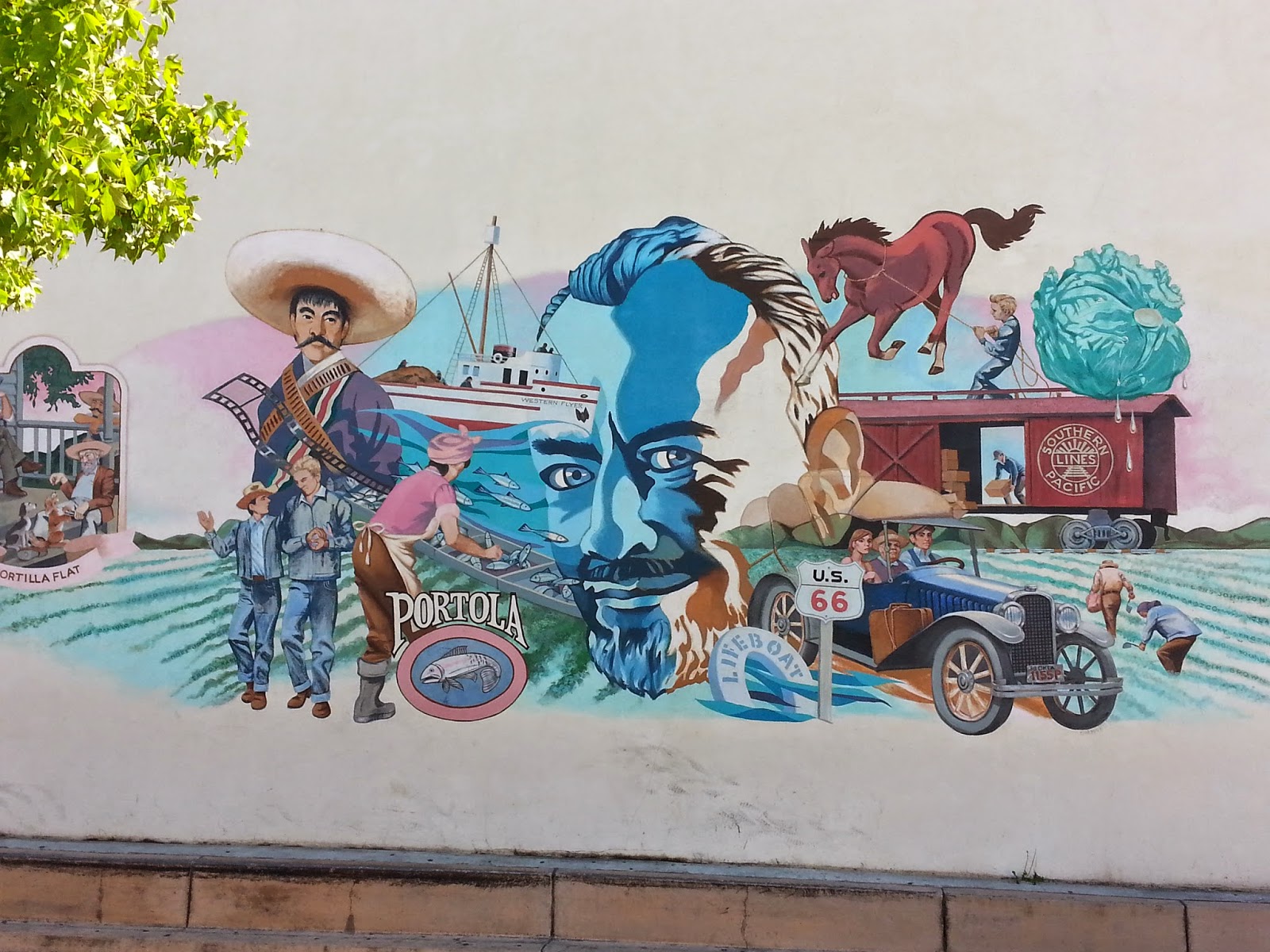
Outside the National Steinbeck Center
Just got back from a great trip, which included a stop in Salinas, CA. I'm tired now, but maybe I'll write more about it later.
Monday, August 4, 2014
"The Wrath of Grapes"
In yesterday's New York Times story about how people are moving to cities like Oklahoma City because the housing prices are cheaper, there's a particularly interesting passage:
“A large percentage of Americans had to read ‘The Grapes of Wrath,’ ”
said Mayor Mick Cornett of Oklahoma City, referring to the John Steinbeck
novel that chronicled the flight of Oklahomans to California in search of
a better life during the Depression. Now the grandchildren and great-
grandchildren of those migrants are returning for the same reason.
“It’s ‘The Wrath of Grapes,’ ” he said.
What Shaila Dewan (the author of this piece) - and maybe the mayor of Oklahoma City, too - doesn't seem to take into account is that in the novel, this "flight," this move "in search of a better life," is compelled - unless you wanted to live like Muley, a character as stubborn as the animal he shares a name with, you fled because the bank made you. Sure, there were aspirations of plentiful work, delicious fruit to harvest and eat, and houses with white fences in the promised land of California, but the dream of those aspirations was necessitated because of real distress, actual limited material conditions. After all, without a tractor plowing into your house, you wouldn't have to fantasize about a new one.
Similar echoes are heard in Dewan's interviews with people who have moved to Oklahoma: a woman who left Portland, OR, because "the beach isn't going to pay my rent"; a man who "had given up on the idea of home ownership in Seattle." It may not be as dire as the Dust Bowl, but it's not as innocuous as a simple "search" for a better life, either.
I don't mean to pounce on the wording in this piece; I know that the article's point is not to discuss The Grapes of Wrath. But how we distill stories matters and the NYT knows this from, to cite just one example, covering one school's teaching of The Great Gatsby and the reactions that followed. And I do think that beyond a mayor's perhaps playful dissing and boosterism, there's a fuller story to be told about the characters who left Oklahoma in the '30s and the ones who head there today.
“A large percentage of Americans had to read ‘The Grapes of Wrath,’ ”
said Mayor Mick Cornett of Oklahoma City, referring to the John Steinbeck
novel that chronicled the flight of Oklahomans to California in search of
a better life during the Depression. Now the grandchildren and great-
grandchildren of those migrants are returning for the same reason.
“It’s ‘The Wrath of Grapes,’ ” he said.
What Shaila Dewan (the author of this piece) - and maybe the mayor of Oklahoma City, too - doesn't seem to take into account is that in the novel, this "flight," this move "in search of a better life," is compelled - unless you wanted to live like Muley, a character as stubborn as the animal he shares a name with, you fled because the bank made you. Sure, there were aspirations of plentiful work, delicious fruit to harvest and eat, and houses with white fences in the promised land of California, but the dream of those aspirations was necessitated because of real distress, actual limited material conditions. After all, without a tractor plowing into your house, you wouldn't have to fantasize about a new one.
Similar echoes are heard in Dewan's interviews with people who have moved to Oklahoma: a woman who left Portland, OR, because "the beach isn't going to pay my rent"; a man who "had given up on the idea of home ownership in Seattle." It may not be as dire as the Dust Bowl, but it's not as innocuous as a simple "search" for a better life, either.
I don't mean to pounce on the wording in this piece; I know that the article's point is not to discuss The Grapes of Wrath. But how we distill stories matters and the NYT knows this from, to cite just one example, covering one school's teaching of The Great Gatsby and the reactions that followed. And I do think that beyond a mayor's perhaps playful dissing and boosterism, there's a fuller story to be told about the characters who left Oklahoma in the '30s and the ones who head there today.
Saturday, August 2, 2014
The logic of "the only way"
It was page 38 in The Grapes of Wrath before I snapped to attention. Here's what's happening right before this scene: the bank is telling Oklahoma tenant farmers that it's taking their land away, land they've lived and worked on sometimes for generations. The man hired by the bank drives up on a tractor and begins to plow. On his lunch break, the farmer recognizes him:

75 years later, I could feel the anger, desperation, and personal, divergent logic of both men's calculations: three dollars, fifteen or twenty families, five thousand acres. With the words "got to think of my own kids," I thought about how, as old as our country's sense of public duty is, the ideology of "my family first" is not brand new, either. And there are reasons for this that can go beyond the solipsism created by a consumer-focused society, as this passage reminded me: economics and fear continue to drive people to focus on the needs of their immediate families instead of the larger world or even their neighbors. And the face of the powerful institution is often still a worker trying to get by where their ability to do so is dependent on an inability to be moved to act by another person's math.
75 years later, I could feel the anger, desperation, and personal, divergent logic of both men's calculations: three dollars, fifteen or twenty families, five thousand acres. With the words "got to think of my own kids," I thought about how, as old as our country's sense of public duty is, the ideology of "my family first" is not brand new, either. And there are reasons for this that can go beyond the solipsism created by a consumer-focused society, as this passage reminded me: economics and fear continue to drive people to focus on the needs of their immediate families instead of the larger world or even their neighbors. And the face of the powerful institution is often still a worker trying to get by where their ability to do so is dependent on an inability to be moved to act by another person's math.
Saturday, June 28, 2014
Twenty Years after the Band
Tonight I watched "The Normal Heart," the HBO movie based on Larry Kramer's play. It brought back a lot of memories, namely reading And the Band Played On: Politics, People, and the AIDS Epidemic in 1994 when I was 14.
Kramer is a pivotal character in Randy Shilts's comprehensive masterwork of journalism, and one of the many names I carried around on my tongue as an impassioned ninth grader. Others included Cleve Jones, Anthony Fauci, Gaetan Dugas. I wasn't discriminating in my enthusiasm; I talked about the activists, the doctors, and so-called Patient Zero with equal intensity. It was the first book I had read where I memorized information eagerly, of my own volition, the way some kids memorize baseball card stats, and I went around talking about Factor VIII and Kaposi's sarcoma to anyone who would listen. A lot has faded, but enough has remained that when I was watching an episode of Veep recently, and the vice president introduced her assistant as Gary Walsh, I thought, Really? You gave him the same last name? Walsh was a psychotherapist described in Shilts's book, and he died in those early years.
When it was all going on (Shilts's book focuses on 1980-85), I was a little kid in North Dakota; born in 1979, I was totally unaware of the medical fear and bravery, political stonewalling and activism, and all the other facets that played out and on and on, especially in major American cities. In 1994, when I truly became aware, it was already an old disease in some ways; Life and Time were naming it as the cause of death in their year-end issues with photos of the famous who had died. I had saved the issues from 1992 and 1993, and I taped the men from those years to my bedroom walls alongside a painting my brother had done of a cheeseburger and fries, alongside my poster for the film It's a Wonderful Life. My room became even stranger than before, a fangirl-shrine-museum for Rudolf Nureyev, Arthur Ashe, Tony Perkins, Denholm Elliott, and others. I went further back in time and taped up Roy Cohn's obituary, even though he was a known asshole. And I taped up Randy's.
When I finished his book, in January or February of 1994, I wrote Randy Shilts a letter to thank him for his work and to ask how I could help, but instead of hearing from him, his assistant wrote back: he was too sick to reply himself. Shortly later he died; my father handed me his obituary one day when I came home from school. I was stunned, blinking back tears. "People with AIDS die," he told me. "They die." Maybe he was merely trying for directness, honesty; maybe my attachment to these faces, the display of gay men in my bedroom, irritated him. Either way, I had to get out of the house. I went for a walk. The roads were lined with pristine snow, making the sudden sight of a squirrel's crushed body all the more vivid and jarring. Of course it wasn't just a dead animal; it felt significant, and I went home and wrote a bad poem about the whole thing.
Back then I wasn't allowed to volunteer at the Southeastern Connecticut AIDS Project (SECAP) because I was a minor, so I wore a red ribbon until that felt flimsy, and then I took it off and did nothing at all. Soon another phrase entered my vocabulary: protease inhibitors. AIDS, while still deadly, ceased to be the same kind of disease, and sentences like the ones my father uttered became relics of a particular time.
"The Normal Heart" is good and sad. It reminded me of a time when I was passionate and single-minded and young and sheltered enough not to know anything of the true fight. It reminded me of those names, of the people who did the living and fighting and dying. I didn't know what to do with these feelings, so for now I'm just writing, again.
Kramer is a pivotal character in Randy Shilts's comprehensive masterwork of journalism, and one of the many names I carried around on my tongue as an impassioned ninth grader. Others included Cleve Jones, Anthony Fauci, Gaetan Dugas. I wasn't discriminating in my enthusiasm; I talked about the activists, the doctors, and so-called Patient Zero with equal intensity. It was the first book I had read where I memorized information eagerly, of my own volition, the way some kids memorize baseball card stats, and I went around talking about Factor VIII and Kaposi's sarcoma to anyone who would listen. A lot has faded, but enough has remained that when I was watching an episode of Veep recently, and the vice president introduced her assistant as Gary Walsh, I thought, Really? You gave him the same last name? Walsh was a psychotherapist described in Shilts's book, and he died in those early years.
When it was all going on (Shilts's book focuses on 1980-85), I was a little kid in North Dakota; born in 1979, I was totally unaware of the medical fear and bravery, political stonewalling and activism, and all the other facets that played out and on and on, especially in major American cities. In 1994, when I truly became aware, it was already an old disease in some ways; Life and Time were naming it as the cause of death in their year-end issues with photos of the famous who had died. I had saved the issues from 1992 and 1993, and I taped the men from those years to my bedroom walls alongside a painting my brother had done of a cheeseburger and fries, alongside my poster for the film It's a Wonderful Life. My room became even stranger than before, a fangirl-shrine-museum for Rudolf Nureyev, Arthur Ashe, Tony Perkins, Denholm Elliott, and others. I went further back in time and taped up Roy Cohn's obituary, even though he was a known asshole. And I taped up Randy's.
When I finished his book, in January or February of 1994, I wrote Randy Shilts a letter to thank him for his work and to ask how I could help, but instead of hearing from him, his assistant wrote back: he was too sick to reply himself. Shortly later he died; my father handed me his obituary one day when I came home from school. I was stunned, blinking back tears. "People with AIDS die," he told me. "They die." Maybe he was merely trying for directness, honesty; maybe my attachment to these faces, the display of gay men in my bedroom, irritated him. Either way, I had to get out of the house. I went for a walk. The roads were lined with pristine snow, making the sudden sight of a squirrel's crushed body all the more vivid and jarring. Of course it wasn't just a dead animal; it felt significant, and I went home and wrote a bad poem about the whole thing.
Back then I wasn't allowed to volunteer at the Southeastern Connecticut AIDS Project (SECAP) because I was a minor, so I wore a red ribbon until that felt flimsy, and then I took it off and did nothing at all. Soon another phrase entered my vocabulary: protease inhibitors. AIDS, while still deadly, ceased to be the same kind of disease, and sentences like the ones my father uttered became relics of a particular time.
"The Normal Heart" is good and sad. It reminded me of a time when I was passionate and single-minded and young and sheltered enough not to know anything of the true fight. It reminded me of those names, of the people who did the living and fighting and dying. I didn't know what to do with these feelings, so for now I'm just writing, again.
Sunday, June 1, 2014
A Sunday Run
There are two churches within three blocks of my apartment, and running by the congregants who are filing in wearing their Sunday best makes me feel like Leslie from Bridge to Terabithia, if she had lived.
Sunday, August 7, 2011
Harry Potter and the Audacious Author
Over (non-butter)beers the other night, a friend and I discussed the recent ending of the "Harry Potter" franchise and sundry related topics, including J.K. Rowling's 2007 outing of her Dumbledore character as gay. I remember that at the time I was outraged that an author would impose a vision of a character retroactively; if it wasn't explicit in the book, I railed to my roommates (designated innocent bystanders to my rants, 2002-2007), it by definition couldn't be declared true. A gay Dumbledore was a legitimate interpretation, based on the text, but nothing more.
Reading Edward Rothstein's appraisal of the situation made me feel instantly calmer; I wasn't alone (and he thought of perspectives I hadn't considered). For example:
The pure-bloods here are blinded by their pride, but Harry and his friends see something more profound, a threat that goes beyond self-interest and identity. This is why Dumbledore’s supposed gayness is ultimately as unimportant as Ron’s shabby clothes. These wounded outsiders recognize the nature of evil, and finally that is what matters.
Whatever you think of Rowling's statement, it does feel like a particularly noticeable piece of a larger picture. Now not only do authors add to their works by producing new books, but between those there are infinite opportunities (and, some would argue, necessities) for self-promotion and production: multi-media interviews, articles, columns, blog posts, and more. And sure it helps to be a Rowling if you want people to pay attention, but anyone can seek (and find) an audience, however small. And if your job (as mine is about to be) is to analyze a work, how much of this extra information do you incorporate - or leave aside? If your assignment is a book published in 2009 and you find a blog entry by that author from last week - is that relevant?
One of the nice things about a series ending is that you can look back on it, whole, and see patterns and themes and know it's complete. You can talk about it as an entity in a way you can't while it's still in progress. Even with a single work, editors can insert new or restore old material into it in later versions and those can both inform and exist separately from the earlier editions. (You see this in everything from E.T.'s 20th anniversary edition replacing police officer's guns with walkie-talkies to the 1995 edition of The Diary of a Young Girl restoring entries dealing with sexuality that Otto Frank had omitted from the original). But when an author says after publication, "My character is X," well, what should we call that? Pulling a Rowling?
Reading Edward Rothstein's appraisal of the situation made me feel instantly calmer; I wasn't alone (and he thought of perspectives I hadn't considered). For example:
The pure-bloods here are blinded by their pride, but Harry and his friends see something more profound, a threat that goes beyond self-interest and identity. This is why Dumbledore’s supposed gayness is ultimately as unimportant as Ron’s shabby clothes. These wounded outsiders recognize the nature of evil, and finally that is what matters.
Whatever you think of Rowling's statement, it does feel like a particularly noticeable piece of a larger picture. Now not only do authors add to their works by producing new books, but between those there are infinite opportunities (and, some would argue, necessities) for self-promotion and production: multi-media interviews, articles, columns, blog posts, and more. And sure it helps to be a Rowling if you want people to pay attention, but anyone can seek (and find) an audience, however small. And if your job (as mine is about to be) is to analyze a work, how much of this extra information do you incorporate - or leave aside? If your assignment is a book published in 2009 and you find a blog entry by that author from last week - is that relevant?
One of the nice things about a series ending is that you can look back on it, whole, and see patterns and themes and know it's complete. You can talk about it as an entity in a way you can't while it's still in progress. Even with a single work, editors can insert new or restore old material into it in later versions and those can both inform and exist separately from the earlier editions. (You see this in everything from E.T.'s 20th anniversary edition replacing police officer's guns with walkie-talkies to the 1995 edition of The Diary of a Young Girl restoring entries dealing with sexuality that Otto Frank had omitted from the original). But when an author says after publication, "My character is X," well, what should we call that? Pulling a Rowling?
Saturday, June 25, 2011
North Seattle vs. North Seattle
Last December, Dani Shapiro reviewed "Poser," Claire Dederer's memoir of regaining her life through yoga, for the New York Times's Sunday Book Review. I have not read the book but plan to if only to tease out for myself what is tongue-in-cheek and what is earnest. For instance, this paragraph (from Shapiro's review; italics mine):
“We were a generation of hollow-eyed women, chasing virtue,” she tells us. “We, the mothers of North Seattle, were consumed with trying to do everything right.” North Seattle — a first cousin of Park Slope, the Upper West Side, Berkeley and dozens of other such enclaves around the country — was a place where attachment parenting was all the rage. Kids weren’t weaned until they spoke in full sentences. Families all slept in the same bed; ate the same organic, locally produced food; and lived in an enriching environment safe from the dangers of plastic toys and disposable diapers.
Is Dederer making fun of the idea that all mothers in one section of a city could be monolithic? Or is she subscribing to that very idea? Furthermore, is Shapiro echoing Dederer when she lumps North Seattle in with other stereotyped areas - or is this her own take on the situation? The word "affluence" never appears in this paragraph. But it doesn't have to.
Homonyms are words that look and sound the same but have different meanings. The phenomenon I want a name for today is the sense of dislocation one feels when one encounters an unexpected homonym; North Seattle, in the quotation from the book and in the review, is that for me. The North Seattle I know does encompass the wide-stroller-wielding, latte-sipping women of Dederer's Green Lake. But it also includes the mom headed to the new DSHS offices at North Seattle Community College for food or work assistance and the women, some mothers themselves, caring for a gaggle of preschoolers, many of whom have mothers who must go to work, at Lake City library's story time.
Satirical or earnest, my hope for "Poser" is that it doesn't commit the sin of omission, of erasing those other mothers of North Seattle. I'll report back after I've read the book.
“We were a generation of hollow-eyed women, chasing virtue,” she tells us. “We, the mothers of North Seattle, were consumed with trying to do everything right.” North Seattle — a first cousin of Park Slope, the Upper West Side, Berkeley and dozens of other such enclaves around the country — was a place where attachment parenting was all the rage. Kids weren’t weaned until they spoke in full sentences. Families all slept in the same bed; ate the same organic, locally produced food; and lived in an enriching environment safe from the dangers of plastic toys and disposable diapers.
Is Dederer making fun of the idea that all mothers in one section of a city could be monolithic? Or is she subscribing to that very idea? Furthermore, is Shapiro echoing Dederer when she lumps North Seattle in with other stereotyped areas - or is this her own take on the situation? The word "affluence" never appears in this paragraph. But it doesn't have to.
Homonyms are words that look and sound the same but have different meanings. The phenomenon I want a name for today is the sense of dislocation one feels when one encounters an unexpected homonym; North Seattle, in the quotation from the book and in the review, is that for me. The North Seattle I know does encompass the wide-stroller-wielding, latte-sipping women of Dederer's Green Lake. But it also includes the mom headed to the new DSHS offices at North Seattle Community College for food or work assistance and the women, some mothers themselves, caring for a gaggle of preschoolers, many of whom have mothers who must go to work, at Lake City library's story time.
Satirical or earnest, my hope for "Poser" is that it doesn't commit the sin of omission, of erasing those other mothers of North Seattle. I'll report back after I've read the book.
Saturday, May 14, 2011
The Casting Couch in My Mind
I am unable to read a short story or novel without imagining the characters as real people. In a newspaper article, I can read about Dr. X from institution Y without pausing, but in a book I would have to decide she was Alfre Woodard before I could continue.
Many times a character is introduced before he or she is fully described; then I have to cast as best as I can, sometimes stopping later on to re-envision. But sometimes I just ignore elements of the author's description if I feel that my choice captures the essence of the character. For instance, in my favorite book from 2010, A Visit from the Goon Squad, I cast Gillian Jacobs (best known as Britta on Community) as one of the central characters, Sasha, even though the character has red hair and the actress doesn't. Can I just dye the actress's hair in my mind? Um, no - not unless I've seen her in a role with red hair.
This process might sound cumbersome - or crazy! - but usually takes less than a minute and isn't confined to famous people; if a friend, co-worker or family member fits the part best, that person gets the role. When I worked at an after school program, those kids populated any stories with children. And now that I don't know as many kids, well, let's just say that the girls from "Nurse Jackie" have had lots of work.
I've found articles and blog posts fiercely debating the casting choices for a beloved book-turned-movie. (See "The Hunger Games" for a recent example). But I'm not finding picks for books with no immediate film plans, which makes me wonder: is this visualization practice common, but we only hear, "I always saw Robert Downey Jr. in the role," when Hollywood gets involved? Or is it relatively rare?
There are teacher guides and scholarly articles commending visualization as a reading comprehension tool. But those count "visualization" as imagining anything in the text, from setting to vocabulary. The need for actual people to populate stories isn't involuntary, so it's not synesthesia. But what is it?
Many times a character is introduced before he or she is fully described; then I have to cast as best as I can, sometimes stopping later on to re-envision. But sometimes I just ignore elements of the author's description if I feel that my choice captures the essence of the character. For instance, in my favorite book from 2010, A Visit from the Goon Squad, I cast Gillian Jacobs (best known as Britta on Community) as one of the central characters, Sasha, even though the character has red hair and the actress doesn't. Can I just dye the actress's hair in my mind? Um, no - not unless I've seen her in a role with red hair.
This process might sound cumbersome - or crazy! - but usually takes less than a minute and isn't confined to famous people; if a friend, co-worker or family member fits the part best, that person gets the role. When I worked at an after school program, those kids populated any stories with children. And now that I don't know as many kids, well, let's just say that the girls from "Nurse Jackie" have had lots of work.
I've found articles and blog posts fiercely debating the casting choices for a beloved book-turned-movie. (See "The Hunger Games" for a recent example). But I'm not finding picks for books with no immediate film plans, which makes me wonder: is this visualization practice common, but we only hear, "I always saw Robert Downey Jr. in the role," when Hollywood gets involved? Or is it relatively rare?
There are teacher guides and scholarly articles commending visualization as a reading comprehension tool. But those count "visualization" as imagining anything in the text, from setting to vocabulary. The need for actual people to populate stories isn't involuntary, so it's not synesthesia. But what is it?
Friday, March 20, 2009
The Terry O'Quinn Phenomenon
What do you think of when you hear or see the words "John Locke"? Do you think of ideas like the social contract or the time of the Enlightenment? Do you think of a dead guy sometimes depicted as having white hair? Or do you think of a tall, muscular, bald actor on a hit TV show?
In my last post I talked about the phenomenon of knowing a derivative before an original. What happens when large portions of society have this experience?
A friend once quoted the movie "My Best Friend's Wedding" as being the source of "This too shall pass." I never went to church as a child, and even I knew that this phrase was older than Julia Roberts' career.
But does it really matter if we don't credit the Bible where credit is due? What harm is done, especially if it's an honest mistake? Besides, the Bible, like any old work, has been the inspiration for countless other works. Those can be enjoyed without knowing their source.
But from Kurt Vonnegut and his Paul Proteus to J.K. Rowling and her Dolores Umbridge, creators are winking at us knowingly when they name their characters, when they make allusions, and they're trying to say something larger about the universe they've constructed. What happens when we don't get the reference?
In my last post I talked about the phenomenon of knowing a derivative before an original. What happens when large portions of society have this experience?
A friend once quoted the movie "My Best Friend's Wedding" as being the source of "This too shall pass." I never went to church as a child, and even I knew that this phrase was older than Julia Roberts' career.
But does it really matter if we don't credit the Bible where credit is due? What harm is done, especially if it's an honest mistake? Besides, the Bible, like any old work, has been the inspiration for countless other works. Those can be enjoyed without knowing their source.
But from Kurt Vonnegut and his Paul Proteus to J.K. Rowling and her Dolores Umbridge, creators are winking at us knowingly when they name their characters, when they make allusions, and they're trying to say something larger about the universe they've constructed. What happens when we don't get the reference?
Subscribe to:
Posts (Atom)