 |
| Gus, played by the great John Hancock. I guess I like images of characters on landlines, huh? |
First, the gist: Gus Thompson works with Steven at PBS. (We've met Gus before in previous episodes; more on that in a bit). The Thompsons - Gus, wife Maya, and son-home-from-Harvard Michael - decide to move into the house across the street from the Keatons. The Thompsons start receiving threatening mail and phone calls; the Keatons call a neighborhood meeting, which quickly turns sour when a neighbor says that his family is going to move because property values are sure to go down now that a black family has arrived in the neighborhood; other neighbors seem likely to follow suit. Faced with such animosity, Maya and Michael want to move; Gus doesn't want to cede literal or moral ground to the bigots. Then their home is broken into, trashed, and vandalized.
 |
| As Nussbaum notes, the Thompsons' home is graffitied "rather politely." The misspelling is turned into a joke. |
During the clean up, Michael's mind is changed about moving as he reflects on a picture of his parents at the March on Washington and what Dr. King would do in their situation. "You and your friends fought long and hard to win us certain basic rights," Michael tells his parents. "And now it's my turn to fight for them."
 |
| Keith Amos is the son, Michael |
The episode ends with other white neighbors arriving to help clean up - property concerns kept them silent, but violence shames them into action - and with Steven altering the offensive graffiti.
 |
| "You could have this man arrested for defacing your property," Alex tells Gus. |
Nussbaum notes:
for a flashing moment, the episode threatens a critique from within: the Keatons
are called on the carpet for their smugly self-congratulatory white liberalism. But
as always in the V.S.E., the conflict quickly dissolves.
She is describing the scene where Steven and Elyse go over to the Thompsons to apologize for the neighborhood meeting. "And even though it didn't work out here," Maya says, "we still appreciate everything you did for us."
"Oh yes" Gus adds, "especially the part where you encouraged us to move into this bastion of racial equality."
 |
| Rosalind Cash plays Maya |
Steven and Elyse worry that the Thompsons blame them for the racism they encountered; they tell them no, and Maya reassures Elyse that they're "so pure of heart that it never occurs to you that others aren't," and it's clear that we're supposed to share this view. Really? These seasoned '60s activists are that innocent?
While I agree with Nussbaum that the "critique from within" is short-lived, I think she overlooks a few other moments in the episode that have resonance. For example, Alex calls Gus to warn him that Steven and Elyse are headed over after the meeting. "They've been singing some of those white protest songs," Gus reports to his family. "Let's make a run for it," Michael responds, and his parents nod, but they don't get very far before the doorbell rings. "I work with the guy," Gus sighs. "You two save yourselves." Here the audience is let in on how these black characters feel about white characters' "self-congratulatory white liberalism," and because the interaction takes place away from the white characters, no reassurances to them mitigate it.
We're also invited to laugh at Steven and Elyse when the Thompsons first discuss the possibility of moving in and want to know the racial makeup of the neighborhood. Gus expresses concern that there are no black families there, and Steven says, "I want you to know this neighborhood is not like that. We've lived here 15 years and there's never been one racial incident." The studio audience laughs, and then Alex adds, "That's a pretty impressive record for a one-race neighborhood."
But this a Very Special Episode, and a sitcom, and so there are limits to its examinations. When Jennifer asks why they live in an all-white neighborhood, Elyse says that it didn't used to be; when they moved in it wasn't, and that was one of the things the family appreciated about it. No one notes that the Keatons possibly contributed to the racial change, that their presence helped make it that much whiter.
 |
| These two sing "Blowin' in the Wind" to the annoyance of everyone around them. |
So what does this particular VSE have to offer us 11 years after Nussbuam's article and 25 years after it aired? For one, TV shows still try to mix humor with critique when discussing racism, but now we're much more likely to find that mix in a comedy news show than a sitcom - and we're more likely to see a figure like Jon Stewart as a font of insight and guidance about these issues than we ever were Michael Gross or Meredith Baxter-Birney. But if we're "waiting" for Stewart to "give Fox News the takedown," does that mean that when his 10 minute monologue is over, we'll feel that we've achieved a resolution? And will that resolution feel more or less tidy than the ending of "All in the Neighborhood"? Regarding Stewart's piece about coverage of the Michael Brown shooting, a friend of mine wrote in an email, "He really showed them, now back to his delightful interview with the star of Guardians of the Galaxy." To be fair, Stewart's guest that night was more substantial, but Sudeep's point is still valid: like the VSE, our comedy sources dip into the difficult and damning issues of our time only to leap back to lighter fare; the difference now is that we look to our comedies for news, too.

This Family Ties episode also relates to the Ferguson, MO, story in the ways Gus is made palatable to white audiences. Gus and Alex share musical tastes: they both love polka and Lawrence Welk, and Alex is particularly upset to see that Gus's Welk records have been destroyed in the vandalism. It can't be a writerly accident that Gus's affinities align with those of the white man who happens to be the most popular character on the show. The actor John Hancock was a large man; for viewers unfamiliar with Gus from earlier episodes, polka and Welk offer reassurance that this large black man is not dangerous. Jelani Cobb wrote of such signs of reassurance in a recent piece for The New Yorker about Michael Brown:
I was once a linebacker-sized eighteen-year-old, too. What I knew then, what
black people have been required to know, is that there are few things more
dangerous than the perception that one is a danger….I sometimes let slip that
I’m a professor or that I’m scarcely even familiar with the rules of football, minor
biographical facts that stand in for a broader, unspoken statement of
reassurance: there is no danger here.
The difference of course is that Cobb is a real person who has chosen which biographical facts to share (even if, having shared them, he feels "a sense of having compromised"). Gus isn't given enough of a story for us to know if he's emphasizing minor biographical facts to better fit in with the Keatons; his likes are attached to him with no sense of agency.
Gus is given so little agency, in fact, that even though he's been around since season two, he has a whole new family for "All in the Neighborhood"! Here they are in the season three episode where the PBS station has a pledge drive:
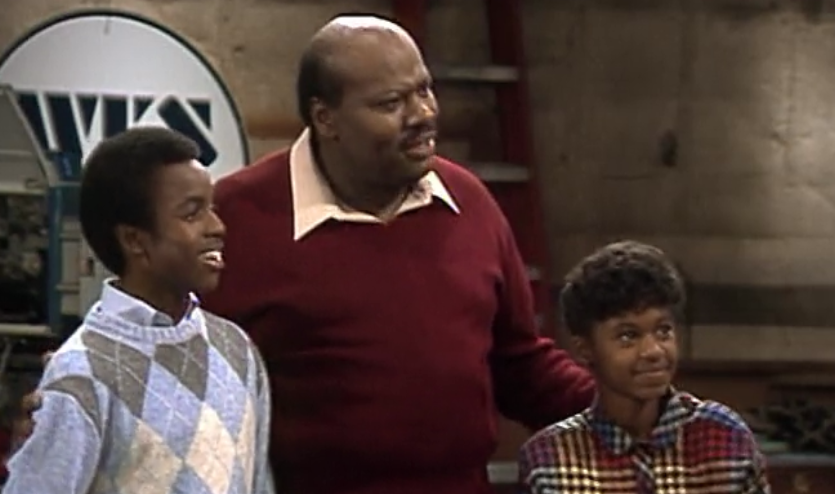
Not only is the son played by a different actor, but also in season three he has a different name - Bill - and the daughter, Judy? Well, she's totally gone by season seven. (The actress who plays his wife is seen so quickly that she doesn't get a name or a credit). I've written about the show's continuity issues before, so it's not like these casting irregularities surprise me. But they add to the impression that Gus is underdeveloped and the actor John Hancock underused.
And this underutilizing is doubly sad because Hancock died of a heart attack only three years later, in 1992. I've been checking guest actors' bios on imdb because I want to write an in memoriam post about some of the ones who have died, and I've tried not to be biased in favor of the old by assuming that they're the only ones who could have died in the past 25-plus years. But I was shocked to discover that all three of the main guest actors in "All in the Neighborhood" have died: Hancock in '92; Rosalind Cash of cancer in 1995, and Keith Amos of chronic asthma in 1998. The parent actors were only in their 50s; the son, in his 30s. It's so obvious, but it still bears saying: there's so much they never got to experience, on TV and in life, and so much they were spared seeing unchanged.


