I recently read The True American, Anand Giridharadas’s account of the 9/11-motivated shootings of gas station workers in Texas. Rais Bhuiyan was the last of the three men shot by Mark Stroman - the others were Indian and Pakistani - and the only one who lived. Rais was a Bangladeshi man who had lived in New York City and who had recently relocated to Dallas; Mark was a native Texan with the signs of white supremacy tattooed on his body. I read this passage soon after the shootings at the AME church in Charleston and the parallels with that shooter’s flag-adorned jacket jumped out at me:
And a few days later I read this series of tweets from Jamelle Bouie, a writer for Slate:
And I thought about what I was up to last summer, reading The Grapes of Wrath and watching Family Ties, among other things, and I remembered the dance episode where Alex has two dates, one of whom is the wonderful Daphne Zuniga. The theme of their high school dance? "Gone with the Wind." I went back to the episode, vaguely remembering it; in it, Alex describes how they're going to transform the gym into a "magnificent Civil War plantation." But it was worse than that; check out what decorates one wall:
This is the Confederate nostalgia that Bouie wrote of, not as extreme as a direct paean to Robert E. Lee, but in its presentation as innocuous, arguably all the more insidious.
Speaking of Michael J. Fox vehicles, I also recently read a great piece about the Mad Men finale (spoiler alert!) that discussed one of the real creators of the Coke ad, an African American advertising executive named Roquel "Billy" Davis. Tim Carmody argues that Mad Men erased Davis, much like Back to the Future erases Chuck Berry by suggesting that Marty McFly inspired “Johnny B. Goode”:
In Back to the Future, this little bit of songwriting-musical-chairs-as-temporal paradox is a joke. It’s a clever contemporary pop-culture reference for the audience, who (one assumes) knows how it all really turned out. But it’s a joke with a nasty center, parked at the end of a movie that, for all its charms, kind of plays like an unapologetic nostalgia-fest for the 1950s. You know — the old, oppressive, fully-segregated bad times that even in Season One, Mad Men is trying to escape.
Is it possible to be nostalgic without erasing vital stories, events, people? Not for the United States, it seems.
Bryan Stevenson knows this, and that’s why he’s working to revive those stories, events, and people through erecting memorials at the sites of violence against African Americans. I heard him on the radio show Here and Now last week and found him completely convincing, though I was a bit frustrated by how consistently the interviewer, Robin Young, embodied the naysayer’s point of view. I know that good interviews require the raising of potential objections, but here I longed for more kudos, more admiration.
Rais Bhuiyan also started an organization, World Without Hate, which works to increase understanding between cultures.
This used to be a blog about ideas and phenomena that seemed like they should have a name. Now it's a blog about that plus other thoughts.
Showing posts with label racism. Show all posts
Monday, July 6, 2015
Wednesday, December 17, 2014
Looking for Lillian Randolph
![]() |
| When a once-prolific actress is no longer easily found. (Credit: Ebony magazine) |
Tis the season for showings of It's a Wonderful Life, the Christmas classic. A few years ago, I went to one of these, at the Grand Illusion theater in Seattle. Watching an old movie with an audience highlights what no longer holds up, and the character of Annie, the Bailey family's African American maid, definitely fell into this category: she has only four or five lines in the whole film, each of which is supposed to be funny; she's portrayed as loyal, nosy, and jovial, dependable for her service and a laugh. But in our seats we mostly greeted her with sounds more approaching groans than chuckles - or with silence.
Boys and girls and music - who needs gin?
I was saving this money for a divorce if I ever got myself a husband!
I have called this movie my favorite; in high school, I had a poster of it on my bedroom wall, Jimmy Stewart lifting Donna Reed in the air. I knew the names of all the actors who played the main characters: Ward Bond, Henry Travers, Beulah Bondi, Lionel Barrymore, and more. But there was one person I didn't know: Lillian Randolph, the actress who played Annie.
| Lillian Randolph (Credit: greatgildersleeve.com) |
I was curious how Randolph felt about Annie, if she spoke directly about the paucity of non-maid roles for black actresses the way her contemporaries Hattie McDaniel and Butterfly McQueen had. So I did some rudimentary searching. Obviously what I found only scratches the surface; media scholars and critics and historians have no doubt covered this material in far greater depth. But I do think what I found is revealing.
Randolph was a radio star, singer, acting teacher, and actress who did voice work and appeared in film and on television up until the year before her death in 1980. Although the website for Ebony magazine returned no results, what I found elsewhere online indicated that she had in fact graced their pages - in 1946, in fact, the year that It's a Wonderful Life was released.
Through my university library, I read an article about trends in radio portrayals of African Americans, which ran in the January 1946 issue (only the third issue of Ebony), and which features a big photograph of Randolph and other actors from the radio show The Great Gildersleeve with the caption WORST SHOW. It continues: "in its malicious maligning of minorities" the show "oozes dialogue in the Octavius Roy Cohn (sic) tradition through the medium of Lillian Randolph who plays the maid Birdie."
Cohen was an author whose most prolific period seems to have been the 1920s; if you're like me and hadn't heard of him, it's probably because, as Paul McCann writes in Race, Music, and National Identity, "His work is grounded in racist caricatures of the African American community and if he is mentioned at all by critics, writers, and historians, it is usually with scorn." So to compare the writing on a radio show to Cohen's was no mild critique.
And it's a charge that Randolph answered. In the April 1946 issue, Ebony published two letters under the header, "In Birdie's Defense," and the first is from Randolph. She writes, "You have a splendid magazine but whoever gave me the criticism I'm sure has never heard the show." She describes the amount of fan mail Gildersleeve has received and continues, "The writers have never put a word of dialect in the script and are particularly careful in the dialogue so as not to offend. I am proud of my race and in no way do I mean to make them ashamed." (The second letter is from Sam Moore, a Gildersleeve writer, who argues that radio needs African American writers. Moore notes, "Surely the central problem, for the sake of good drama as well as a better world, is to present the Negro truly and honestly as a human being, fighting to make a place for himself in a country that for him is still only half a democracy").
This defense of Gildersleeve seems never to have wavered: in a 1976 Those Were the Days radio interview about her career, much of the 22 minutes are devoted to Gildersleeve, which Randolph describes in warm terms. (Although Randolph may be most well-known now for the role of Annie, that part isn't even mentioned in this interview).
Notable moments in this interview include at minute 3:15: "I was taught - this sounds ridiculous, but this was true - I was taught Negro dialect by a Caucasian by the name of James Jewel who was one of the originators of the Lone Ranger…I owe everything I've ever done in radio to Mr. Jewel." (A whole essay could probably be built off of that one excerpt, but I'll just say that at the very least this seems to complicate her claims about dialect and dialogue in the Ebony letter); at 16:09, when she describes her upcoming role on the TV mini-series Roots; and this dialogue at 19:33, after Randolph has discussed a commercial she's going to be in for Wesson Oil:
Interviewer (I believe this is Chuck Schaden): "Keep you in the kitchen a lot, from Kraft mayonnaise to Wesson Oil."
Randolph: "I don't mind it at all. It's work."
And maybe therein lies a partial answer to how Randolph felt about playing so many maids. It was work, and in the case of Gildersleeve, it was work that lasted nearly two decades (compare that to the few minutes she got in It's a Wonderful Life), work that she didn't share with anyone else (unlike the part of Beulah, for example, on the show of the same name, which was played by several actresses), and it was work that she felt aligned with her Christian values. (Near the end of the interview, Randolph talks about turning down jobs that she wouldn't want family or fellow church members to see her in).
Randolph has been recognized for her professional achievements, including being inducted into the Black Filmmakers Hall of Fame, but she's also been erased, as when her voice work on the Tom and Jerry cartoon was dubbed over.
It's a Wonderful Life recognizes and erases Randolph at the same time, too: she shows up in the last scene with the rest of the community, but she's not on the ensemble poster (even though pretty much everyone else is).
| (Credit: impawards.com) |
Watching the movie in that theater, we were also recognizing and erasing - seeing her on the screen, but wishing an uncomfortable depiction of race and labor away. But those of us who still cycle It's a Wonderful Life through our holiday viewing should look carefully, instead; we won't find all of Randolph through Annie, but we will learn something about the opportunities available to African American women at the time, actresses and not. We'll learn about work, race, and gender. We'll learn something about our own time, too, about the movies we make now, and the implications of continuing to love what we have loved.
***
Addendum: Years ago I watched a clip of something - a movie? TV show? Music video? I can't remember - that showed a young African American man returning home one night to find his grandparents watching It's a Wonderful Life. He paused to look at them, shook his head, and left the room. The implication was that their generation was out-of-touch to still enjoy such a film. Does anyone know the name of the movie, TV show, etc., with this scene?
Saturday, October 11, 2014
Why Are Almost all of These Women White?
C'mon, Grey Lady, get it together. It's only been a few weeks since The New York Times caused an uproar for publishing Alessandra Stanley's inaccurate, clueless, and offensive piece about Shonda Rhimes and her TV creations. One of the conclusions that Margaret Sullivan, the Public Editor, reached was that a lack of diversity in the ranks of culture editors could have contributed to the piece's publication; she notes that, "among the 15 culture editors...just a few are nonwhite."
Now this week's Sunday Book Review is focused on Women & Power, and what do you see when you scroll (or flip) through the contents? Of the 13 photos or drawings of women or girls that accompany each article, 11 are white. (I'm providing the link here although it appears that the table of contents in this order will only be available until the next Book Review replaces it). There's Diane Sawyer, Lena Dunham, Gail Sheehy, and Kirsten Gillibrand, among others, and then there's Sonia Sotomayor and a story about The Underground Girls of Kabul, which chronicles the practice of passing girls off as boys in Afghanistan (one such girl and her mother appear in the accompanying photo). Two books profiling nonwhite women, two images; that's it. This even when some stories - such as a piece about abortion rights and the origins of birth control pills - involve and affect all women and are illustrated with drawings, drawings that easily could have depicted nonwhite women.
At the end of her piece about the Stanley article, Sullivan wrote, "This contentious chapter may not seem like a welcome gift to anyone involved. But if The Times takes it seriously – looking hard at its diversity and its editing practices — it can be exactly that." It's clear that The Times isn't looking hard enough; I plan to email Sullivan to tell her just that.
Now this week's Sunday Book Review is focused on Women & Power, and what do you see when you scroll (or flip) through the contents? Of the 13 photos or drawings of women or girls that accompany each article, 11 are white. (I'm providing the link here although it appears that the table of contents in this order will only be available until the next Book Review replaces it). There's Diane Sawyer, Lena Dunham, Gail Sheehy, and Kirsten Gillibrand, among others, and then there's Sonia Sotomayor and a story about The Underground Girls of Kabul, which chronicles the practice of passing girls off as boys in Afghanistan (one such girl and her mother appear in the accompanying photo). Two books profiling nonwhite women, two images; that's it. This even when some stories - such as a piece about abortion rights and the origins of birth control pills - involve and affect all women and are illustrated with drawings, drawings that easily could have depicted nonwhite women.
At the end of her piece about the Stanley article, Sullivan wrote, "This contentious chapter may not seem like a welcome gift to anyone involved. But if The Times takes it seriously – looking hard at its diversity and its editing practices — it can be exactly that." It's clear that The Times isn't looking hard enough; I plan to email Sullivan to tell her just that.
Wednesday, August 27, 2014
Still Working on that Solid Rock of Brotherhood
Well, I've finally done it - no, I haven't quite finished re-watching Family Ties, but I have arrived at the last season's two-part Very Special Episode "All in the Neighborhood" where the Keatons rediscover racism. The VSE was TV centered around one issue, and like any sitcom episode, viewers got closure at the end - the difference being, the VSE offered closure about something complex, like racism. Emily Nussbaum wrote a great piece about the phenomenon of the nearly-vanished VSE and "All in the Neighborhood" when it aired as a rerun on Nickelodeon in 2003; 11 years later, it's all worth revisiting.
First, the gist: Gus Thompson works with Steven at PBS. (We've met Gus before in previous episodes; more on that in a bit). The Thompsons - Gus, wife Maya, and son-home-from-Harvard Michael - decide to move into the house across the street from the Keatons. The Thompsons start receiving threatening mail and phone calls; the Keatons call a neighborhood meeting, which quickly turns sour when a neighbor says that his family is going to move because property values are sure to go down now that a black family has arrived in the neighborhood; other neighbors seem likely to follow suit. Faced with such animosity, Maya and Michael want to move; Gus doesn't want to cede literal or moral ground to the bigots. Then their home is broken into, trashed, and vandalized.
During the clean up, Michael's mind is changed about moving as he reflects on a picture of his parents at the March on Washington and what Dr. King would do in their situation. "You and your friends fought long and hard to win us certain basic rights," Michael tells his parents. "And now it's my turn to fight for them."
The episode ends with other white neighbors arriving to help clean up - property concerns kept them silent, but violence shames them into action - and with Steven altering the offensive graffiti.
Nussbaum notes:
for a flashing moment, the episode threatens a critique from within: the Keatons
are called on the carpet for their smugly self-congratulatory white liberalism. But
as always in the V.S.E., the conflict quickly dissolves.
She is describing the scene where Steven and Elyse go over to the Thompsons to apologize for the neighborhood meeting. "And even though it didn't work out here," Maya says, "we still appreciate everything you did for us."
"Oh yes" Gus adds, "especially the part where you encouraged us to move into this bastion of racial equality."
Steven and Elyse worry that the Thompsons blame them for the racism they encountered; they tell them no, and Maya reassures Elyse that they're "so pure of heart that it never occurs to you that others aren't," and it's clear that we're supposed to share this view. Really? These seasoned '60s activists are that innocent?
While I agree with Nussbaum that the "critique from within" is short-lived, I think she overlooks a few other moments in the episode that have resonance. For example, Alex calls Gus to warn him that Steven and Elyse are headed over after the meeting. "They've been singing some of those white protest songs," Gus reports to his family. "Let's make a run for it," Michael responds, and his parents nod, but they don't get very far before the doorbell rings. "I work with the guy," Gus sighs. "You two save yourselves." Here the audience is let in on how these black characters feel about white characters' "self-congratulatory white liberalism," and because the interaction takes place away from the white characters, no reassurances to them mitigate it.
We're also invited to laugh at Steven and Elyse when the Thompsons first discuss the possibility of moving in and want to know the racial makeup of the neighborhood. Gus expresses concern that there are no black families there, and Steven says, "I want you to know this neighborhood is not like that. We've lived here 15 years and there's never been one racial incident." The studio audience laughs, and then Alex adds, "That's a pretty impressive record for a one-race neighborhood."
But this a Very Special Episode, and a sitcom, and so there are limits to its examinations. When Jennifer asks why they live in an all-white neighborhood, Elyse says that it didn't used to be; when they moved in it wasn't, and that was one of the things the family appreciated about it. No one notes that the Keatons possibly contributed to the racial change, that their presence helped make it that much whiter.
So what does this particular VSE have to offer us 11 years after Nussbuam's article and 25 years after it aired? For one, TV shows still try to mix humor with critique when discussing racism, but now we're much more likely to find that mix in a comedy news show than a sitcom - and we're more likely to see a figure like Jon Stewart as a font of insight and guidance about these issues than we ever were Michael Gross or Meredith Baxter-Birney. But if we're "waiting" for Stewart to "give Fox News the takedown," does that mean that when his 10 minute monologue is over, we'll feel that we've achieved a resolution? And will that resolution feel more or less tidy than the ending of "All in the Neighborhood"? Regarding Stewart's piece about coverage of the Michael Brown shooting, a friend of mine wrote in an email, "He really showed them, now back to his delightful interview with the star of Guardians of the Galaxy." To be fair, Stewart's guest that night was more substantial, but Sudeep's point is still valid: like the VSE, our comedy sources dip into the difficult and damning issues of our time only to leap back to lighter fare; the difference now is that we look to our comedies for news, too.
This Family Ties episode also relates to the Ferguson, MO, story in the ways Gus is made palatable to white audiences. Gus and Alex share musical tastes: they both love polka and Lawrence Welk, and Alex is particularly upset to see that Gus's Welk records have been destroyed in the vandalism. It can't be a writerly accident that Gus's affinities align with those of the white man who happens to be the most popular character on the show. The actor John Hancock was a large man; for viewers unfamiliar with Gus from earlier episodes, polka and Welk offer reassurance that this large black man is not dangerous. Jelani Cobb wrote of such signs of reassurance in a recent piece for The New Yorker about Michael Brown:
I was once a linebacker-sized eighteen-year-old, too. What I knew then, what
black people have been required to know, is that there are few things more
dangerous than the perception that one is a danger….I sometimes let slip that
I’m a professor or that I’m scarcely even familiar with the rules of football, minor
biographical facts that stand in for a broader, unspoken statement of
reassurance: there is no danger here.
The difference of course is that Cobb is a real person who has chosen which biographical facts to share (even if, having shared them, he feels "a sense of having compromised"). Gus isn't given enough of a story for us to know if he's emphasizing minor biographical facts to better fit in with the Keatons; his likes are attached to him with no sense of agency.
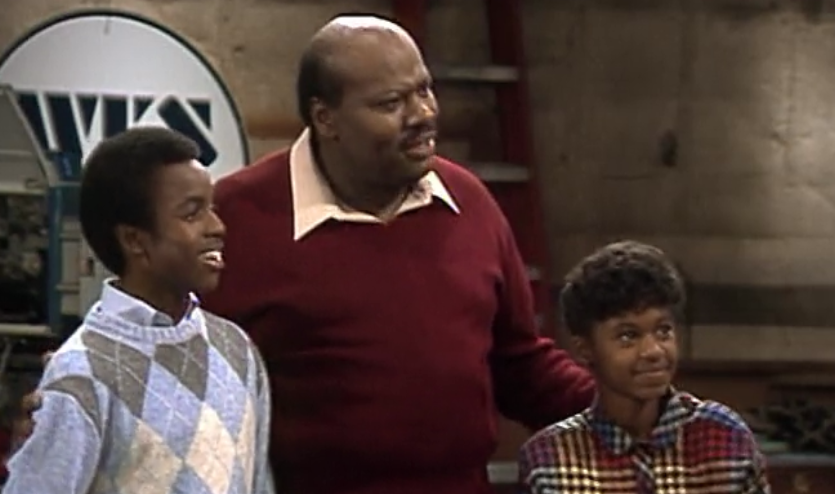
Gus is given so little agency, in fact, that even though he's been around since season two, he has a whole new family for "All in the Neighborhood"! Here they are in the season three episode where the PBS station has a pledge drive:
Not only is the son played by a different actor, but also in season three he has a different name - Bill - and the daughter, Judy? Well, she's totally gone by season seven. (The actress who plays his wife is seen so quickly that she doesn't get a name or a credit). I've written about the show's continuity issues before, so it's not like these casting irregularities surprise me. But they add to the impression that Gus is underdeveloped and the actor John Hancock underused.
And this underutilizing is doubly sad because Hancock died of a heart attack only three years later, in 1992. I've been checking guest actors' bios on imdb because I want to write an in memoriam post about some of the ones who have died, and I've tried not to be biased in favor of the old by assuming that they're the only ones who could have died in the past 25-plus years. But I was shocked to discover that all three of the main guest actors in "All in the Neighborhood" have died: Hancock in '92; Rosalind Cash of cancer in 1995, and Keith Amos of chronic asthma in 1998. The parent actors were only in their 50s; the son, in his 30s. It's so obvious, but it still bears saying: there's so much they never got to experience, on TV and in life, and so much they were spared seeing unchanged.
![]() |
| Gus, played by the great John Hancock. I guess I like images of characters on landlines, huh? |
First, the gist: Gus Thompson works with Steven at PBS. (We've met Gus before in previous episodes; more on that in a bit). The Thompsons - Gus, wife Maya, and son-home-from-Harvard Michael - decide to move into the house across the street from the Keatons. The Thompsons start receiving threatening mail and phone calls; the Keatons call a neighborhood meeting, which quickly turns sour when a neighbor says that his family is going to move because property values are sure to go down now that a black family has arrived in the neighborhood; other neighbors seem likely to follow suit. Faced with such animosity, Maya and Michael want to move; Gus doesn't want to cede literal or moral ground to the bigots. Then their home is broken into, trashed, and vandalized.
![]() |
| As Nussbaum notes, the Thompsons' home is graffitied "rather politely." The misspelling is turned into a joke. |
During the clean up, Michael's mind is changed about moving as he reflects on a picture of his parents at the March on Washington and what Dr. King would do in their situation. "You and your friends fought long and hard to win us certain basic rights," Michael tells his parents. "And now it's my turn to fight for them."
![]() |
| Keith Amos is the son, Michael |
The episode ends with other white neighbors arriving to help clean up - property concerns kept them silent, but violence shames them into action - and with Steven altering the offensive graffiti.
![]() |
| "You could have this man arrested for defacing your property," Alex tells Gus. |
Nussbaum notes:
for a flashing moment, the episode threatens a critique from within: the Keatons
are called on the carpet for their smugly self-congratulatory white liberalism. But
as always in the V.S.E., the conflict quickly dissolves.
She is describing the scene where Steven and Elyse go over to the Thompsons to apologize for the neighborhood meeting. "And even though it didn't work out here," Maya says, "we still appreciate everything you did for us."
"Oh yes" Gus adds, "especially the part where you encouraged us to move into this bastion of racial equality."
![]() |
| Rosalind Cash plays Maya |
Steven and Elyse worry that the Thompsons blame them for the racism they encountered; they tell them no, and Maya reassures Elyse that they're "so pure of heart that it never occurs to you that others aren't," and it's clear that we're supposed to share this view. Really? These seasoned '60s activists are that innocent?
While I agree with Nussbaum that the "critique from within" is short-lived, I think she overlooks a few other moments in the episode that have resonance. For example, Alex calls Gus to warn him that Steven and Elyse are headed over after the meeting. "They've been singing some of those white protest songs," Gus reports to his family. "Let's make a run for it," Michael responds, and his parents nod, but they don't get very far before the doorbell rings. "I work with the guy," Gus sighs. "You two save yourselves." Here the audience is let in on how these black characters feel about white characters' "self-congratulatory white liberalism," and because the interaction takes place away from the white characters, no reassurances to them mitigate it.
We're also invited to laugh at Steven and Elyse when the Thompsons first discuss the possibility of moving in and want to know the racial makeup of the neighborhood. Gus expresses concern that there are no black families there, and Steven says, "I want you to know this neighborhood is not like that. We've lived here 15 years and there's never been one racial incident." The studio audience laughs, and then Alex adds, "That's a pretty impressive record for a one-race neighborhood."
But this a Very Special Episode, and a sitcom, and so there are limits to its examinations. When Jennifer asks why they live in an all-white neighborhood, Elyse says that it didn't used to be; when they moved in it wasn't, and that was one of the things the family appreciated about it. No one notes that the Keatons possibly contributed to the racial change, that their presence helped make it that much whiter.
![]() |
| These two sing "Blowin' in the Wind" to the annoyance of everyone around them. |
So what does this particular VSE have to offer us 11 years after Nussbuam's article and 25 years after it aired? For one, TV shows still try to mix humor with critique when discussing racism, but now we're much more likely to find that mix in a comedy news show than a sitcom - and we're more likely to see a figure like Jon Stewart as a font of insight and guidance about these issues than we ever were Michael Gross or Meredith Baxter-Birney. But if we're "waiting" for Stewart to "give Fox News the takedown," does that mean that when his 10 minute monologue is over, we'll feel that we've achieved a resolution? And will that resolution feel more or less tidy than the ending of "All in the Neighborhood"? Regarding Stewart's piece about coverage of the Michael Brown shooting, a friend of mine wrote in an email, "He really showed them, now back to his delightful interview with the star of Guardians of the Galaxy." To be fair, Stewart's guest that night was more substantial, but Sudeep's point is still valid: like the VSE, our comedy sources dip into the difficult and damning issues of our time only to leap back to lighter fare; the difference now is that we look to our comedies for news, too.
This Family Ties episode also relates to the Ferguson, MO, story in the ways Gus is made palatable to white audiences. Gus and Alex share musical tastes: they both love polka and Lawrence Welk, and Alex is particularly upset to see that Gus's Welk records have been destroyed in the vandalism. It can't be a writerly accident that Gus's affinities align with those of the white man who happens to be the most popular character on the show. The actor John Hancock was a large man; for viewers unfamiliar with Gus from earlier episodes, polka and Welk offer reassurance that this large black man is not dangerous. Jelani Cobb wrote of such signs of reassurance in a recent piece for The New Yorker about Michael Brown:
I was once a linebacker-sized eighteen-year-old, too. What I knew then, what
black people have been required to know, is that there are few things more
dangerous than the perception that one is a danger….I sometimes let slip that
I’m a professor or that I’m scarcely even familiar with the rules of football, minor
biographical facts that stand in for a broader, unspoken statement of
reassurance: there is no danger here.
The difference of course is that Cobb is a real person who has chosen which biographical facts to share (even if, having shared them, he feels "a sense of having compromised"). Gus isn't given enough of a story for us to know if he's emphasizing minor biographical facts to better fit in with the Keatons; his likes are attached to him with no sense of agency.
Gus is given so little agency, in fact, that even though he's been around since season two, he has a whole new family for "All in the Neighborhood"! Here they are in the season three episode where the PBS station has a pledge drive:
Not only is the son played by a different actor, but also in season three he has a different name - Bill - and the daughter, Judy? Well, she's totally gone by season seven. (The actress who plays his wife is seen so quickly that she doesn't get a name or a credit). I've written about the show's continuity issues before, so it's not like these casting irregularities surprise me. But they add to the impression that Gus is underdeveloped and the actor John Hancock underused.
And this underutilizing is doubly sad because Hancock died of a heart attack only three years later, in 1992. I've been checking guest actors' bios on imdb because I want to write an in memoriam post about some of the ones who have died, and I've tried not to be biased in favor of the old by assuming that they're the only ones who could have died in the past 25-plus years. But I was shocked to discover that all three of the main guest actors in "All in the Neighborhood" have died: Hancock in '92; Rosalind Cash of cancer in 1995, and Keith Amos of chronic asthma in 1998. The parent actors were only in their 50s; the son, in his 30s. It's so obvious, but it still bears saying: there's so much they never got to experience, on TV and in life, and so much they were spared seeing unchanged.
Subscribe to:
Posts (Atom)