This summer I taught a class, re-watched Family Ties, and finally read The Grapes of Wrath, which I loved and was not alone in finding unfortunately yet inspiringly still relevant. So I was excited to visit the National Steinbeck Center in Salinas, CA. If you haven't been, and you're a mostly-uninformed Steinbeck admirer to any degree, I recommend it. I learned about his reporting - on migrant workers and World War II, among other subjects - how the themes of The Grapes of Wrath earned him an invitation to Russia at the start of the Cold War (not exactly a common occurrence), and how critical derision about him receiving the Nobel Prize in Literature caused him to give up writing fiction. (It eventually became clear that he never truly gave it up). I learned about books I'd never knew he'd written - In Dubious Battle, about a farm workers' strike; The Winter of our Discontent, about consumerism and morality in the U.S. - and was reminded of America and Americans, a collection of essays and the last book of his published while he was alive.
There was also a very cool exhibit about a group that recreated the Joads' journey from Oklahoma to California to mark the 75th anniversary of The Grapes of Wrath; they collected oral histories from workers, activists, and other people, some of which are shared in the exhibit. (You can find more info about it here, too; although it says the exhibit ended in July, they must have decided to extend it).
But the center was also disappointing and odd: if you were unlike me and were mostly-informed about Steinbeck, there's little offered that you won't already know; the main exhibit is large and contains a lot of information, but there's no commentary, let alone analysis, that seeks to puzzle out themes, arcs, or evolutions in his life or work or tie them to contemporary issues. (The possible exception is a collection of "Steinbeck in the news"-type clippings, but it was dominated by stories of the recent big-name Broadway revival of Of Mice and Men). And in some cases, there are frustrating, gaping holes: a display of Steinbeck's college correspondence names the recipient but nothing about who she was.
What's also odd is the museum's apparent desire to satisfy both adults and children; there are a lot of interactive features, some of which can cross generations. (For example, the In Dubious Battle section includes two candlestick telephones; you pick up the receiver to hear dialogue from the book). But others, such as a red pony that children can climb onto, well, not so much. I've never read The Red Pony, but a cursory glance at some search results reveals that it's generally taught at the 6th grade level or higher. But the museum pony seems aimed at much younger kids (or middle schoolers who want to - wait for it! - horse around). It's great to try to get kids excited about literature, but at what point are book-related activities made so accessible to young ages, the "related" part stretched so thin, that the book itself is lost? When kids have a chance to practice braiding a rope, are they learning about a book or about…braiding a rope? Meanwhile, the adults among you are wondering, Who was that woman he wrote the letters to?!
I'm a sucker for the interactive as much as the next person; when I see a question in a big font asking, "How did Lennie want his beans?" and the instruction, "Lift the can," I lift the can. (Spoiler alert: there's a bottle of ketchup under them thar can). Then later in my trip, when I'm reading an educational display in Redwood National and State Parks about what makes redwoods so resilient, and it ends with the question, "What do you think is the biggest threat to redwoods today?", my first thought is, What do I lift to find the answer?!
Then I think: oh, right. Humans.
Showing posts with label The Grapes of Wrath. Show all posts
Showing posts with label The Grapes of Wrath. Show all posts
Monday, September 15, 2014

Friday, September 12, 2014
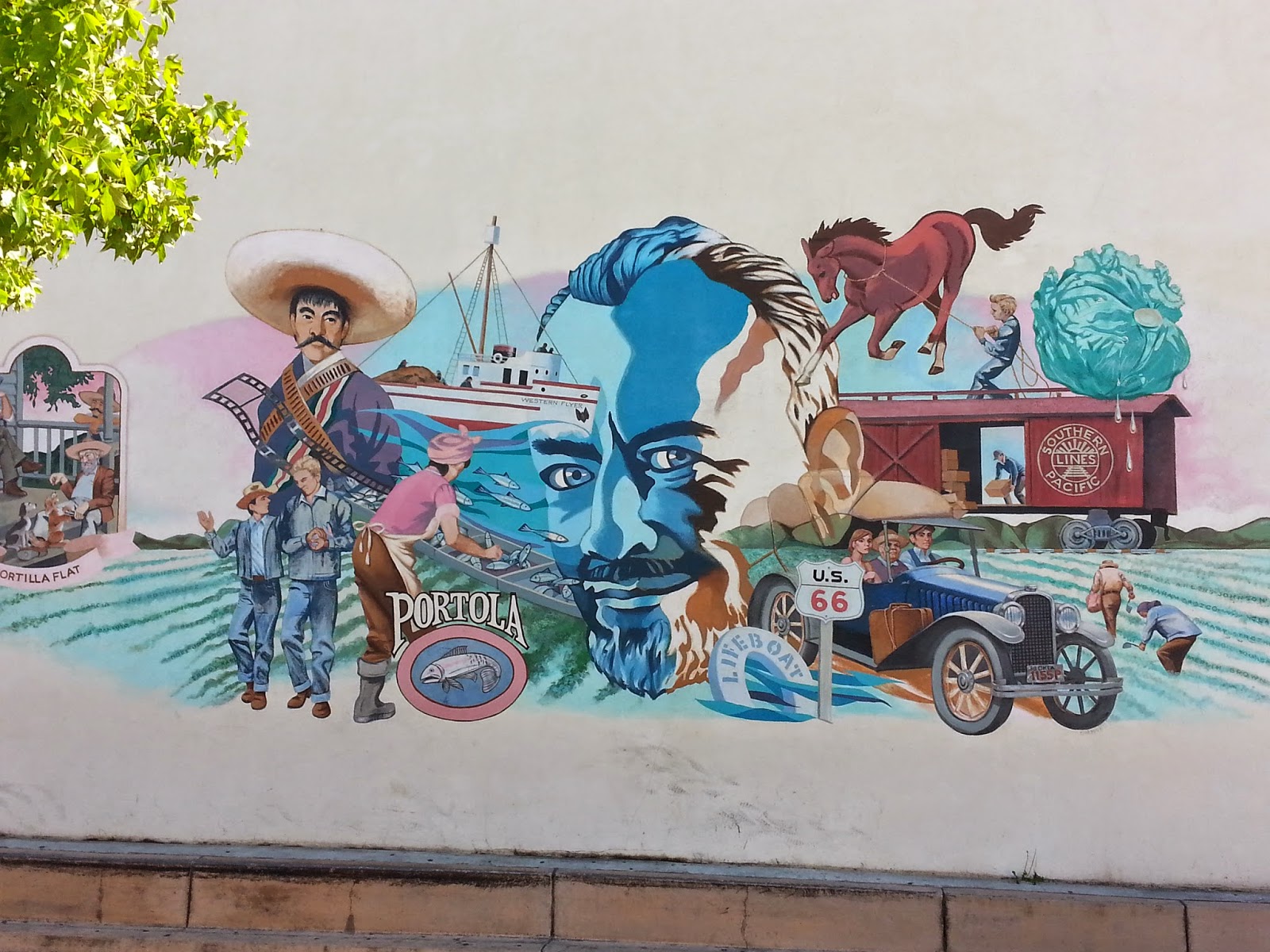
Outside the National Steinbeck Center
Just got back from a great trip, which included a stop in Salinas, CA. I'm tired now, but maybe I'll write more about it later.
Thursday, August 21, 2014
"The Okies of the Great Recession"
I finished The Grapes of Wrath and the next day when I bought a copy of Harper's, I found this story about retirement-age adults who live in RVs and travel the country following seasonal work. Jessica Bruder writes:
They call themselves workampers, travelers, nomads, and gypsies, while
history-minded commentators have labeled them the Okies of the Great
Recession. More bluntly, they are geriatric migrant labor, meeting demands
for seasonal work in an increasingly fragmented, temp-driven marketplace.
And whatever you call them, they're part of a demographic that in the past
several years has grown with alarming speed: downwardly mobile older
Americans.
I highly recommend reading this piece; if you're like me and had no idea about this group of people, you'll find it informative, frequently mind-boggling, and yet also an expected extension of economic and social trends. Just as the Joads find community in some places and (when there is work) hard work for little pay almost everywhere, the people Bruder interviews create communities at RV camps yet work long, exhausting days at Amazon warehouses and other sites. But one difference is that there are no Jim Casys in the 2014 story, no workers on strike.
They call themselves workampers, travelers, nomads, and gypsies, while
history-minded commentators have labeled them the Okies of the Great
Recession. More bluntly, they are geriatric migrant labor, meeting demands
for seasonal work in an increasingly fragmented, temp-driven marketplace.
And whatever you call them, they're part of a demographic that in the past
several years has grown with alarming speed: downwardly mobile older
Americans.
I highly recommend reading this piece; if you're like me and had no idea about this group of people, you'll find it informative, frequently mind-boggling, and yet also an expected extension of economic and social trends. Just as the Joads find community in some places and (when there is work) hard work for little pay almost everywhere, the people Bruder interviews create communities at RV camps yet work long, exhausting days at Amazon warehouses and other sites. But one difference is that there are no Jim Casys in the 2014 story, no workers on strike.
Monday, August 4, 2014
"The Wrath of Grapes"
In yesterday's New York Times story about how people are moving to cities like Oklahoma City because the housing prices are cheaper, there's a particularly interesting passage:
“A large percentage of Americans had to read ‘The Grapes of Wrath,’ ”
said Mayor Mick Cornett of Oklahoma City, referring to the John Steinbeck
novel that chronicled the flight of Oklahomans to California in search of
a better life during the Depression. Now the grandchildren and great-
grandchildren of those migrants are returning for the same reason.
“It’s ‘The Wrath of Grapes,’ ” he said.
What Shaila Dewan (the author of this piece) - and maybe the mayor of Oklahoma City, too - doesn't seem to take into account is that in the novel, this "flight," this move "in search of a better life," is compelled - unless you wanted to live like Muley, a character as stubborn as the animal he shares a name with, you fled because the bank made you. Sure, there were aspirations of plentiful work, delicious fruit to harvest and eat, and houses with white fences in the promised land of California, but the dream of those aspirations was necessitated because of real distress, actual limited material conditions. After all, without a tractor plowing into your house, you wouldn't have to fantasize about a new one.
Similar echoes are heard in Dewan's interviews with people who have moved to Oklahoma: a woman who left Portland, OR, because "the beach isn't going to pay my rent"; a man who "had given up on the idea of home ownership in Seattle." It may not be as dire as the Dust Bowl, but it's not as innocuous as a simple "search" for a better life, either.
I don't mean to pounce on the wording in this piece; I know that the article's point is not to discuss The Grapes of Wrath. But how we distill stories matters and the NYT knows this from, to cite just one example, covering one school's teaching of The Great Gatsby and the reactions that followed. And I do think that beyond a mayor's perhaps playful dissing and boosterism, there's a fuller story to be told about the characters who left Oklahoma in the '30s and the ones who head there today.
“A large percentage of Americans had to read ‘The Grapes of Wrath,’ ”
said Mayor Mick Cornett of Oklahoma City, referring to the John Steinbeck
novel that chronicled the flight of Oklahomans to California in search of
a better life during the Depression. Now the grandchildren and great-
grandchildren of those migrants are returning for the same reason.
“It’s ‘The Wrath of Grapes,’ ” he said.
What Shaila Dewan (the author of this piece) - and maybe the mayor of Oklahoma City, too - doesn't seem to take into account is that in the novel, this "flight," this move "in search of a better life," is compelled - unless you wanted to live like Muley, a character as stubborn as the animal he shares a name with, you fled because the bank made you. Sure, there were aspirations of plentiful work, delicious fruit to harvest and eat, and houses with white fences in the promised land of California, but the dream of those aspirations was necessitated because of real distress, actual limited material conditions. After all, without a tractor plowing into your house, you wouldn't have to fantasize about a new one.
Similar echoes are heard in Dewan's interviews with people who have moved to Oklahoma: a woman who left Portland, OR, because "the beach isn't going to pay my rent"; a man who "had given up on the idea of home ownership in Seattle." It may not be as dire as the Dust Bowl, but it's not as innocuous as a simple "search" for a better life, either.
I don't mean to pounce on the wording in this piece; I know that the article's point is not to discuss The Grapes of Wrath. But how we distill stories matters and the NYT knows this from, to cite just one example, covering one school's teaching of The Great Gatsby and the reactions that followed. And I do think that beyond a mayor's perhaps playful dissing and boosterism, there's a fuller story to be told about the characters who left Oklahoma in the '30s and the ones who head there today.
Saturday, August 2, 2014
The logic of "the only way"
It was page 38 in The Grapes of Wrath before I snapped to attention. Here's what's happening right before this scene: the bank is telling Oklahoma tenant farmers that it's taking their land away, land they've lived and worked on sometimes for generations. The man hired by the bank drives up on a tractor and begins to plow. On his lunch break, the farmer recognizes him:

75 years later, I could feel the anger, desperation, and personal, divergent logic of both men's calculations: three dollars, fifteen or twenty families, five thousand acres. With the words "got to think of my own kids," I thought about how, as old as our country's sense of public duty is, the ideology of "my family first" is not brand new, either. And there are reasons for this that can go beyond the solipsism created by a consumer-focused society, as this passage reminded me: economics and fear continue to drive people to focus on the needs of their immediate families instead of the larger world or even their neighbors. And the face of the powerful institution is often still a worker trying to get by where their ability to do so is dependent on an inability to be moved to act by another person's math.
75 years later, I could feel the anger, desperation, and personal, divergent logic of both men's calculations: three dollars, fifteen or twenty families, five thousand acres. With the words "got to think of my own kids," I thought about how, as old as our country's sense of public duty is, the ideology of "my family first" is not brand new, either. And there are reasons for this that can go beyond the solipsism created by a consumer-focused society, as this passage reminded me: economics and fear continue to drive people to focus on the needs of their immediate families instead of the larger world or even their neighbors. And the face of the powerful institution is often still a worker trying to get by where their ability to do so is dependent on an inability to be moved to act by another person's math.
Subscribe to:
Posts (Atom)